AI estimate as of October 2, 2025 · verify with a professional before acting
AI-Generated · Verify before acting
Everything on this page is generated by AI for informational purposes only. AI can make mistakes — the AI may misidentify items or misattribute them (artist, maker, brand, designer, origin, era). This is not an official valuation and should not be used for insurance, sale, tax, estate, legal, or lending purposes — or any decision requiring a certified appraisal. It is not an authoritative claim about any person, brand, or rights holder — do not share or rely on it as a factual statement about a third party. Always consult qualified professionals before making financial decisions.
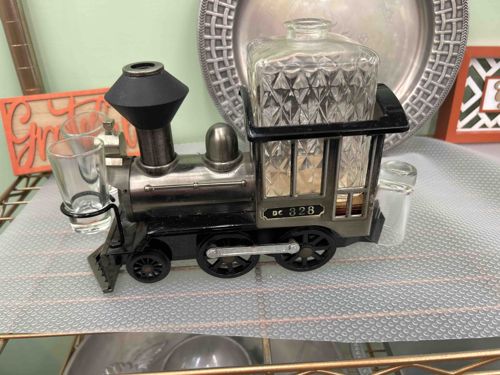
This item is a decorative decanter set, shaped like a vintage steam locomotive, designed to hold and dispense alcoholic beverages. The main body of the 'locomotive' is made of a silver-toned metal, possibly cast aluminum or a similar alloy, with a brushed or satin finish, giving it an antique appearance. It features typical steam engine details such as a prominent black smokestack, a domed sandbox cover, and visible piping and rivets on its 'boiler' section. The wheels are black with silver-colored connecting rods, and the front has a cowcatcher-style bumper. Integrated into the design are holders for small shot glasses; two are clearly visible on the front near the smokestack and one on the rear 'tender' section. The 'tender' portion of the train is where a prominent square-shaped glass decanter is housed. This decanter has a diamond-cut or hobnail pattern on its sides, suggesting a decorative glassware style, and a clear stopper is visible at its top, though it appears to be simple and unadorned. A small plaque on the side of the tender reads 'DC 328', which could be a model number, serial number, or a symbolic designation. The overall construction appears solid and functional, designed for display and use as a novelty barware item. There are no significant signs of wear or damage visible from the provided images, indicating it is likely in good to very good condition. It represents a novelty or vintage barware aesthetic, possibly dating from the mid to late 20th century. The craftsmanship is utilitarian for its purpose, designed to be decorative yet functional.
AI Appraisal Report
Upon visual examination of this Train-shaped Decanter with Shot Glasses, I assess its condition as good to very good. The silver-toned metal shows a consistent brushed finish with no apparent dents, significant scratches, or corrosion, which is remarkable for an item of this type. The black plastic or painted elements, such as the smokestack and wheels, also appear intact. The integrated glass decanter, with its diamond-cut pattern, seems free of chips or cracks, and the clear stopper is present. The 'DC 328' plaque is clearly legible. Authenticity, based solely on imagery, suggests it is a genuine novelty barware item from the mid to late 20th century, likely produced during a period when such decorative and functional pieces were popular. Without a maker's mark or patent number visible, full authentication of a specific manufacturer or exact vintage is challenging from photos alone.
Market conditions for novelty decanter sets of this nature are stable, driven by collectors of unique barware, train enthusiasts, and individuals furnishing retro-themed entertainment spaces. Comparable items, often referred to as 'train decanters' or 'locomotive decanter sets,' typically surface at online auctions and vintage retailers. Demand is moderate, rather than high, as these are niche collectibles. Rarity is not a significant factor; while not mass-produced in contemporary times, similar designs were relatively common in past decades. Factors impacting value include the excellent apparent condition, completeness with shot glasses (though not all are visible), and the decorative appeal. However, the lack of precious metals, significant age, or a renowned maker limits its top-end value. For definitive authentication of materials (e.g., confirming metal composition) or internal flaws in the glass, an in-person examination would be necessary.