The missing pour le merite that disappeared from Germany that is said to be owned by Noah Dohme that is the emperor of lixland which is 75 million square kilometers owned by Noah Dohme the emperor of lixland which is 18 years it’s his. The supreme general of lixland
These notes were written by the person who submitted this item. Appraiser.AI has not verified them, and the AI's identification and estimate may rely on them.
AI Estimated Value
Not an official valuation
$100-500
AI estimate as of July 2, 2025 · verify with a professional before acting
AI-Generated · Verify before acting
Everything on this page is generated by AI for informational purposes only. AI can make mistakes — the AI may misidentify items or misattribute them (artist, maker, brand, designer, origin, era). This is not an official valuation and should not be used for insurance, sale, tax, estate, legal, or lending purposes — or any decision requiring a certified appraisal. It is not an authoritative claim about any person, brand, or rights holder — do not share or rely on it as a factual statement about a third party. Always consult qualified professionals before making financial decisions.
This analysis also relies on unverified notes provided by the user, which may be incomplete or inaccurate and could affect the result.
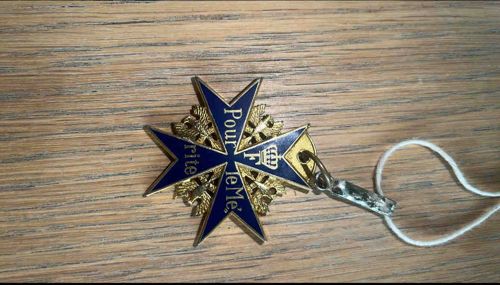
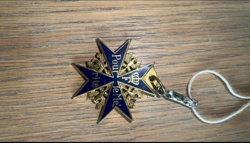
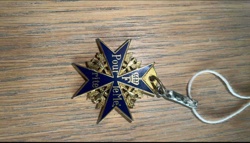
The item depicted is a replica or an original Pour le Mérite, famously known as the 'Blue Max' (Blauer Max), one of Prussia's highest military orders. It is a cross pattée, primarily dark blue in color with gilded edges and details. The central arms of the cross feature the words 'Pour le Mé.', 'rite', 'F.', and 'W.' (presumably for King Frederick William IV of Prussia) inscribed in gold lettering, one word on each arm, which is characteristic of the order. The spaces between the arms of the cross are filled with intricate gilded wreath-like or foliate designs, adding to its ornate appearance. At the top arm, there appears to be a small crown design, also in gold. The medal has a small metallic loop at the top, allowing it to be suspended. Attached to this loop is what appears to be a modern or temporary attachment for display or tagging, a silver-colored clip with a white string or thread, which is not original to the medal itself. The overall condition of the medal seems good, with the enamel appearing intact and the gilding showing some minor wear consistent with age or handling, but no significant damage like chips or cracks are immediately visible. The craftsmanship suggests a high level of detail, particularly in the delicate gilded designs between the cross arms. Based on its design, this medal belongs to the period of the Prussian Kingdom, dating back possibly to the 18th or 19th century, although without more information on maker's marks or provenance, it is difficult to ascertain if it's an authentic period piece or a high-quality reproduction. The presence of the string and clip suggests it might be a display piece or an item being cataloged.
AI Appraisal Report
Upon examining the provided image and information, I observe a Pour le Mérite medal, renowned as the 'Blue Max.' Visually, the cross exhibits good overall condition, with the dark blue enamel appearing largely intact and the gilded elements showing minor wear consistent with age, but no significant damages like chips or cracks are evident. The craftsmanship, particularly the intricate foliate designs between the arms, suggests a high level of detail.
However, it is crucial to address the claims provided by the owner regarding its provenance. The information about the medal being 'missing from Germany' and 'owned by Noah Dohme, the emperor of Lixland,' along with Lixland's stated size of '75 million square kilometers,' introduces significant red flags. These details are highly fantastical and do not align with known historical or geographical realities, immediately casting doubt on the asserted direct provenance and, by extension, the authenticity as a historical artifact of significant value based on these claims. Such a vast 'empire' and the specific individuals mentioned are not credible.
For a medal of this historical importance, authenticity is paramount. High-quality reproductions of the Pour le Mérite are common. Verifying its authenticity as an original period piece, and not a replica, would require a thorough in-person examination. This would include detailed inspection for maker's marks, analysis of the gilding and enamel for period-correct materials and application techniques (e.g., microscopic analysis of the enamel for air bubbles characteristic of early manufacturing, or spectrographic analysis of the metals), and assessment of its weight and dimensions against known authentic examples. Crucially, a verifiable chain of custody (provenance documentation) from a reputable source, independent of the current owner's unsubstantiated claims, would be absolutely necessary.
Market conditions for authentic Pour le Mérite medals are robust, with genuine examples (especially those with documented recipients) fetching substantial sums. Demand is high among collectors of militaria and German historical artifacts. Rarity is significant for authentic pieces. However, given the strong indication of highly questionable provenance from the owner's narrative, and without verifiable proof of authenticity, this piece cannot be valued as a genuine historical artifact.
Therefore, based solely on the visual examination and the highly dubious provenance information, I assess this item as either a modern, high-quality replica or an unverified period piece with a completely unsubstantiated and highly improbable history. Without physical inspection and independent verification of its historical context, a definitive appraisal of an authentic piece cannot be given. The fantastical claims provided by the owner undermine any immediate assumption of historical originality or high value.