AI estimate as of September 29, 2025 · verify with a professional before acting
AI-Generated · Verify before acting
Everything on this page is generated by AI for informational purposes only. AI can make mistakes — the AI may misidentify items or misattribute them (artist, maker, brand, designer, origin, era). This is not an official valuation and should not be used for insurance, sale, tax, estate, legal, or lending purposes — or any decision requiring a certified appraisal. It is not an authoritative claim about any person, brand, or rights holder — do not share or rely on it as a factual statement about a third party. Always consult qualified professionals before making financial decisions.
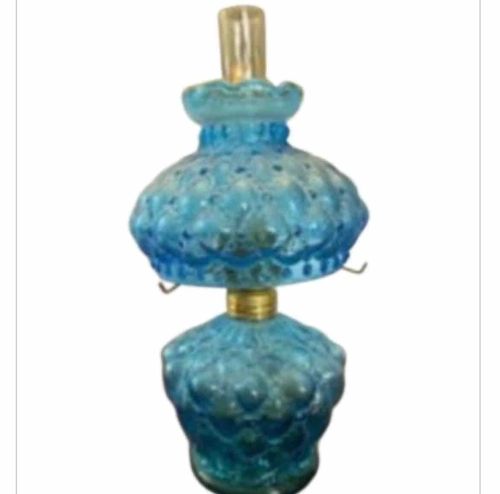
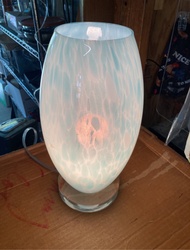
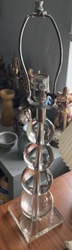
This item is a vintage boudoir or parlor lamp, constructed primarily of translucent blue pressed glass, possibly milk glass or similar opaque colored glass, with brass or brass-tone metal fittings. The lamp features a squat, rounded base and a complementary, dome-shaped shade. Both the base and the shade exhibit a repeating, raised textured pattern, possibly a 'puffy' or 'hobnail' design, which adds visual interest and diffuses light. The blue color appears to be a consistent, somewhat muted aqua or turquoise hue throughout both glass components. A brass-colored collar connects the base to the top portion where the shade rests, and a similar golden-toned ring likely secures the shade to the lamp's electrical components. Wire arms or 'harp' extensions are visible, supporting the shade and keeping it elevated. At the top, a clear glass or plastic chimney-like component is present, which would typically house the light bulb. The overall style suggests a Victorian or early 20th-century aesthetic, possibly dating from the 1930s-1950s. Due to the image quality, specific wear and tear such as chips, cracks, or repairs are not clearly discernible, but general surface wear consistent with age may be expected. The brass components show a natural patina, appearing slightly dulled rather than highly polished. The craftsmanship appears to be typical of mass-produced decorative lighting from the period, with molded glass components. No visible maker's marks or signatures are apparent from the provided images.
AI Appraisal Report
Based on my visual examination of the provided image, this vintage boudoir or parlor lamp, with its translucent blue pressed glass and brass-tone metal fittings, appears to be in good vintage condition, consistent with its likely age. The 'puffy' or textured design on both the base and shade adds aesthetic appeal. The brass components show a natural, unpolished patina, which is desirable and expected for pieces of this era, likely dating from the 1930s-1950s. The blue hue is consistent, suggesting no major fading or discoloration.
Market conditions for vintage decorative lighting, particularly boudoir or parlor lamps of this style, are stable. Lamps of this type, while charming, are not exceedingly rare, and similar examples can often be found at antique markets, online platforms, or estate sales. Demand tends to be moderate, often driven by collectors or individuals seeking specific decorative accents for period-appropriate interiors. Key factors impacting value include the consistent color, intact glass components (free from chips or cracks), and the overall originality of the fittings.
My assessment of authenticity is based solely on visual characteristics from the image. Without a physical in-person examination, it is impossible to definitively verify the absence of chips, cracks, or repairs, especially in the textured glass, which can disguise minor damage. I also cannot confirm the material composition of the fittings (e.g., solid brass vs. brass-plated). An in-person inspection would allow for a thorough condition report, confirmation of material authenticity, and internal inspection of wiring. Additionally, checking for manufacturer's marks or labels, which are not visible in the image, would require physical access. Provenance documentation, if available, would further authenticate its history.