These notes were written by the person who submitted this item. Appraiser.AI has not verified them, and the AI's identification and estimate may rely on them.
AI Estimated Value
Not an official valuation
$75-125
AI estimate as of July 18, 2025 · verify with a professional before acting
AI-Generated · Verify before acting
Everything on this page is generated by AI for informational purposes only. AI can make mistakes — the AI may misidentify items or misattribute them (artist, maker, brand, designer, origin, era). This is not an official valuation and should not be used for insurance, sale, tax, estate, legal, or lending purposes — or any decision requiring a certified appraisal. It is not an authoritative claim about any person, brand, or rights holder — do not share or rely on it as a factual statement about a third party. Always consult qualified professionals before making financial decisions.
This analysis also relies on unverified notes provided by the user, which may be incomplete or inaccurate and could affect the result.
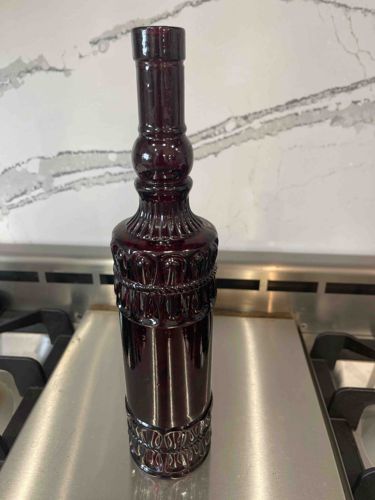
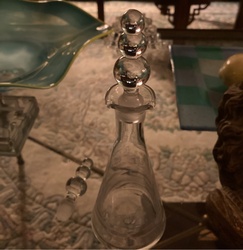
This is a tall, slender glass bottle or decanter, characterized by its deep, rich aubergine or amethyst color, indicating it is likely made from 'amethyst glass.' The bottle stands upright, exhibiting a bulbous, ornate design across its body, tapering to a narrower neck and a wider, stable base. The central part of the body features intricate molded patterns, possibly stylized floral or scroll motifs, adding to its decorative appeal. The base echoes this ornamentation with a similar pattern, providing visual balance. The neck is cylindrical, with a slight bulge before narrowing to the rim. The overall construction suggests it was likely mold-blown glass. The surface appears smooth and glossy, as expected for glass, and exhibits no immediate visible chips, cracks, or significant abrasions from the provided image. The clarity of the glass, despite its deep color, indicates good quality. The context provides '14 OVO on bottom' which likely refers to a mold number or manufacturer's mark, '14 OVO', commonly found on the base of such glass items. This marking could be a significant identifier for the manufacturer or the specific mold used, aiding in dating the piece, possibly to the mid-20th century or earlier, given the decorative style. Its condition appears to be excellent with a good sheen, suggesting it has been well-preserved.
AI Appraisal Report
Upon examining the provided image and description of this Amethyst Glass Ornate Bottle/Decanter, I assess its condition as excellent. The absence of visible chips, cracks, or significant abrasions, coupled with a good sheen, indicates remarkable preservation. The rich amethyst color and intricate molded patterns suggest a piece of decorative glassware likely from the mid-20th century or earlier. The '14 OVO' marking on the bottom is crucial; it appears to be a mold number or manufacturer's indicator, vital for tracing its origin and potentially confirming its age. This type of ornate amethyst glass has a steady, though not exceptionally high, demand in the decorative arts market. Its value is primarily driven by its aesthetic appeal, good condition, and potential historical significance if the '14 OVO' mark can be definitively linked to a known manufacturer with a strong reputation. Similar well-preserved decorative glass bottles or decanters of this era and style typically fetch moderate prices. Rarity plays a role; while amethyst glass itself is not exceedingly rare, a specific design in this excellent condition with an identifiable mark can increase desirability. Factors significantly impacting value include the confirmed manufacturer, the exact manufacturing period, and proven provenance. The main limitation is the inability to conduct an in-person examination. A physical inspection would allow for tactile assessment of glass quality, internal examination for any subtle flaws, and a more precise evaluation of the '14 OVO' mark. Full authentication would ideally require researching the '14 OVO' mark in glass manufacturers' archives, and potentially, if doubt existed, scientific testing of the glass composition itself.