AI estimate as of August 7, 2026 · verify with a professional before acting
AI-Generated · Verify before acting
Everything on this page is generated by AI for informational purposes only. AI can make mistakes — the AI may misidentify items or misattribute them (artist, maker, brand, designer, origin, era). This is not an official valuation and should not be used for insurance, sale, tax, estate, legal, or lending purposes — or any decision requiring a certified appraisal. It is not an authoritative claim about any person, brand, or rights holder — do not share or rely on it as a factual statement about a third party. Always consult qualified professionals before making financial decisions.
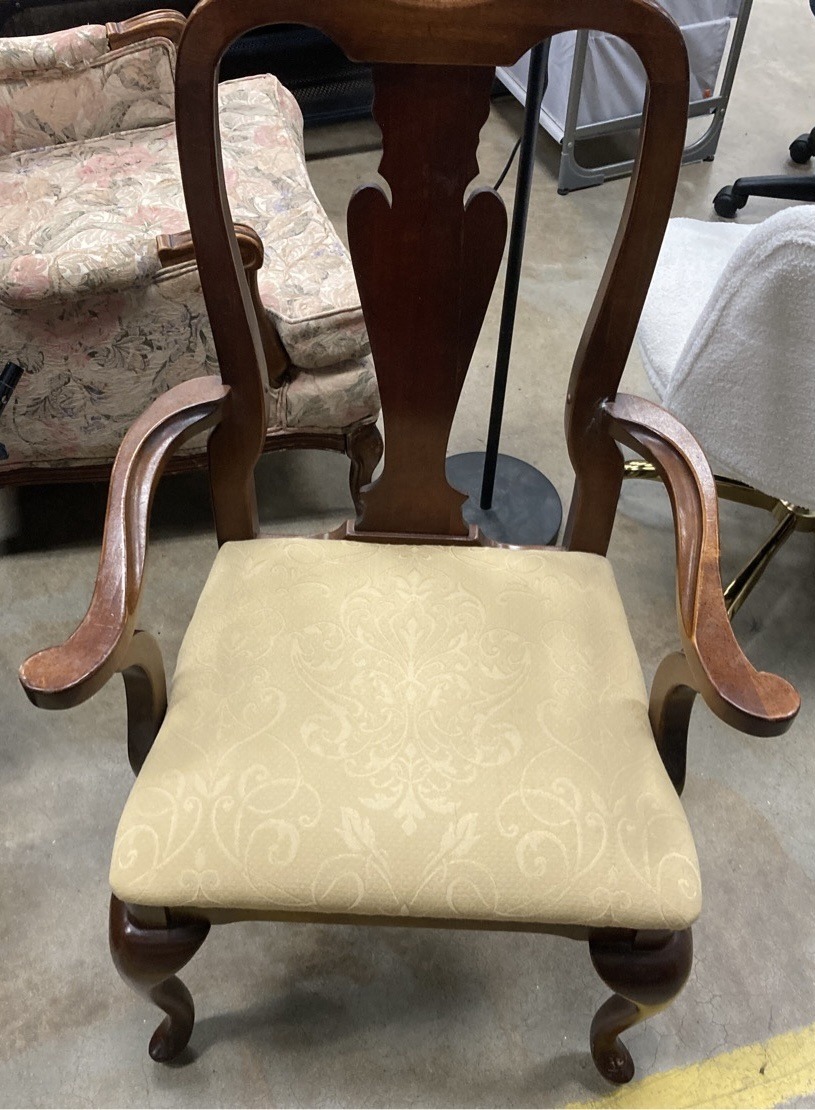
This is an armchair constructed primarily of wood with a warm medium-brown finish, likely mahogany or a similar hardwood with a visible grain. The chair features a prominent vase-shaped splat in the center of the backrest, characteristic of the Queen Anne design style. The curved arms flare outward and show visible wear and scuffing on the top surfaces of the handrests, revealing lighter wood tones beneath the finish. The drop-in or upholstered seat cushion is covered in a light beige or cream-colored woven fabric featuring a subtle, ornate damask-style botanical and scroll pattern. The front legs are cabriole in shape, terminating in pad feet, which is consistent with mid-18th century European and American furniture traditions, though the exact age and manufacturing period remain unverified based on visual inspection alone. There are no clearly legible maker's marks, stamps, or labels visible in the provided image. The overall construction exhibits traditional joinery cues, but condition issues such as surface scratching, finish loss on the high-friction armrests, and minor fabric discoloration indicate moderate past usage. The identification of this piece relies entirely on its silhouette, specifically the splat back and cabriole legs.
AI Appraisal Report
Based on what I can see in the photograph, this armchair exhibits classic Queen Anne design characteristics, including a prominent vase-shaped splat back, curved arms, and cabriole legs terminating in pad feet. The wood features a warm medium-brown finish, and the drop-in seat is upholstered in a light beige damask-style patterned fabric. However, I can't verify from a photo alone the exact age, wood species, or manufacturing period, and I see no clearly legible maker's marks or stamps. Based on the assumption that this piece is a mid-18th-century antique of this style, I estimate a market value range of $800 to $1,200. This estimate accounts for condition issues noted upon visual inspection, specifically the surface scratching, finish loss and scuffing on the handrests, and minor fabric discoloration indicating moderate past usage. General market demand for traditional period seating remains steady among collectors of classic brown furniture, though values heavily depend on physical condition and correct attribution. If physical inspection reveals this piece to be a later 19th or 20th-century reproduction, replica, or made simply 'in the style of' the Queen Anne period rather than an authentic mid-18th-century example, the value would likely decrease significantly, dropping into the $200 to $400 range. To confirm authenticity, age, and true attribution, an in-person examination by a qualified furniture conservator, detailed inspection of traditional joinery and wood aging, and documentation of provenance would be required.