AI estimate as of September 29, 2025 · verify with a professional before acting
AI-Generated · Verify before acting
Everything on this page is generated by AI for informational purposes only. AI can make mistakes — the AI may misidentify items or misattribute them (artist, maker, brand, designer, origin, era). This is not an official valuation and should not be used for insurance, sale, tax, estate, legal, or lending purposes — or any decision requiring a certified appraisal. It is not an authoritative claim about any person, brand, or rights holder — do not share or rely on it as a factual statement about a third party. Always consult qualified professionals before making financial decisions.
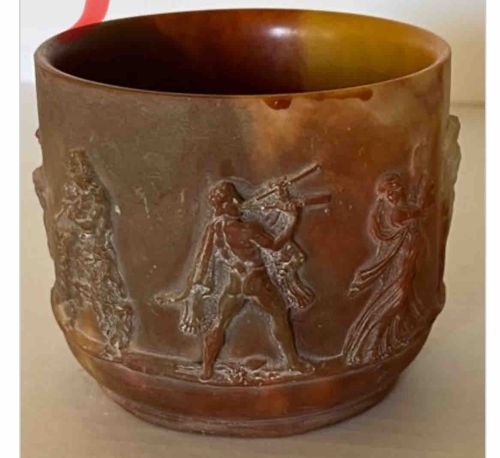
This item is a beaker or cup, likely crafted from horn, exhibiting a deep reddish-brown color that transitions to lighter, more translucent shades of amber and yellow towards the rim. The material appears organic, possibly bovine horn, which is known for its durability and inherent variations in color and translucency. The beaker features a cylindrical body that tapers slightly towards the base. The most prominent characteristic is the intricate bas-relief carving that encircles the exterior. The carving depicts classical or mythological figures, possibly from ancient Greece or Rome. One central figure appears to be a male, possibly a musician or hunter, wearing a draped garment and holding what looks like a stringed instrument or a hunting bow. To his left and right are other draped figures, some in active poses. The carving shows a notable level of detail, especially in the drapery and musculature of the figures, suggesting skilled craftsmanship. There is a distinct border forming a base for these figures, indicating they are situated on a landscape or stage. The surface of the beaker, particularly in the carved areas, shows signs of age and wear, including some whitish residue or accretion in the deeper crevices, and a general dulling of the original luster, suggesting a well-used item or one that has accumulated patina over time. The interior of the cup appears smoother than the exterior, with the natural variegation of the horn material clearly visible. There are no obvious cracks, chips, or significant repairs visible from the provided images, though a thorough inspection would be needed to confirm. The overall aesthetic points to an object of considerable age, likely from the 19th or early 20th century, drawing inspiration from classical antiquity.
AI Appraisal Report
This horn beaker, with its intricate bas-relief carving of classical figures, appears to be an authentic example of decorative arts from the late 19th or early 20th century. The deep reddish-brown horn with amber variations, coupled with the detailed drapery and musculature of the figures, suggests skilled craftsmanship typical of the period when classical motifs were highly popular. The visible wear, including the dulling of luster and whitish residue in crevices, is consistent with age and use, supporting its authenticity rather than indicating a modern reproduction. The condition appears good from the images, with no obvious cracks or major repairs, although a comprehensive in-person inspection would be necessary to confirm this definitively.
Without physical examination, I cannot definitively confirm the material as bovine horn, though it strongly appears to be. For full authentication, I would recommend an in-hand inspection to assess the texture, weight, and internal structure, and possibly chemical analysis if there were any doubts about the organic composition. Provenance documentation would also be invaluable, though often absent for items of this type and age.
Market conditions for carved hornware are generally stable, with a modest demand. While not exceedingly rare, finely carved examples like this do attract collectors interested in classical revival pieces or natural material artistry. Comparable items, typically unauthenticated, sell in the $200-$500 range. The quality of carving here places it towards the higher end of this spectrum. Factors impacting its value negatively would be any hidden damage or modern repairs; positively, a documented history or exceptionally fine preservation would increase its worth. Based on its visual appeal and apparent condition, I estimate its appraisal value to be between $250 and $450.