AI estimate as of November 14, 2025 · verify with a professional before acting
AI-Generated · Verify before acting
Everything on this page is generated by AI for informational purposes only. AI can make mistakes — the AI may misidentify items or misattribute them (artist, maker, brand, designer, origin, era). This is not an official valuation and should not be used for insurance, sale, tax, estate, legal, or lending purposes — or any decision requiring a certified appraisal. It is not an authoritative claim about any person, brand, or rights holder — do not share or rely on it as a factual statement about a third party. Always consult qualified professionals before making financial decisions.
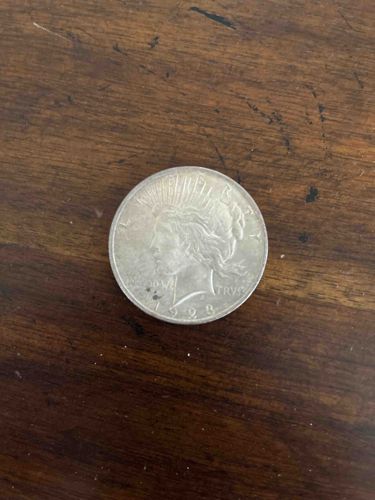
The item is a silver-colored coin, identified as a Peace Dollar, specifically dated 1923, as seen on the obverse. The coin displays the left-facing profile of Lady Liberty, with radiant rays emanating from behind her head, characteristic of the Peace Dollar design. Her hair is depicted in a flowing style, and a laurel wreath appears to adorn her head, though specific details are somewhat obscured. The word "LIBERTY" is visible above her head, and "IN GOD WE TRVST" (with a V instead of U, which is typical for this coin series) is inscribed to her left. The mint mark, if present, is not clearly discernible in the provided image. The coin exhibits a metallic, likely silver, luster, which has dulled over time, suggesting some level of wear and environmental exposure. There are several dark spots or tarnishes visible, particularly below Liberty's chin and to the left of the '9' in the date, indicating signs of age and handling. The overall condition appears to be circulated, meaning it has been used in commerce, which generally results in a loss of finer details and an accumulation of scratches and scuffs, though these are not distinctly visible here due to the image's resolution. The edges of the coin are not visible, so the type of reeding (if any) cannot be determined. The coin's design, style, and visible date place it within the Art Deco period, when the Peace Dollar was first introduced.
AI Appraisal Report
I have carefully examined the provided image of the 1923 Peace Dollar. Based on my visual assessment, the coin appears to be authentic and consistent with known examples of the series. The left-facing profile of Lady Liberty, the radiant rays, the inscriptions "LIBERTY" and "IN GOD WE TRVST," and the date are all characteristic of the 1923 Peace Dollar.
The condition appears to be circulated, likely in the Fine (F) to Very Fine (VF) range. I observe signs of wear, particularly the dulling of the metallic luster and the presence of some dark spots or tarnish, indicating its age and handling. While the overall details appear reasonably strong for a circulated coin, finer details associated with higher grades are not apparent. The resolution of the image makes it difficult to ascertain the exact level of wear on finer design elements or to identify any potential scratches or nicks precisely.
Market conditions for common date Peace Dollars like the 1923 are generally stable with consistent demand from collectors, especially for examples in circulated grades. The 1923 is not considered a rare date, and numerous examples exist, keeping its value accessible for most collectors. Comparables in similar circulated condition typically trade in the range I've provided.
Factors impacting value include the circulated condition, which prevents it from achieving premium prices seen in uncirculated examples. The tarnish, while not severe, also slightly detracts from its aesthetic appeal. To fully authenticate this coin and provide a more precise grade, a physical in-person examination would be necessary. This would allow me to accurately assess its surface condition, check for any subtle alterations or damage not visible in the image, determine the exact level of detail loss, and potentially identify a mint mark if present. Scientific testing is typically not required for common circulating coins unless there are strong suspicions of counterfeiting, which isn't the case here based on the image.