These notes were written by the person who submitted this item. Appraiser.AI has not verified them, and the AI's identification and estimate may rely on them.
AI Estimated Value
Not an official valuation
$40-$60
AI estimate as of July 27, 2025 · verify with a professional before acting
AI-Generated · Verify before acting
Everything on this page is generated by AI for informational purposes only. AI can make mistakes — the AI may misidentify items or misattribute them (artist, maker, brand, designer, origin, era). This is not an official valuation and should not be used for insurance, sale, tax, estate, legal, or lending purposes — or any decision requiring a certified appraisal. It is not an authoritative claim about any person, brand, or rights holder — do not share or rely on it as a factual statement about a third party. Always consult qualified professionals before making financial decisions.
This analysis also relies on unverified notes provided by the user, which may be incomplete or inaccurate and could affect the result.
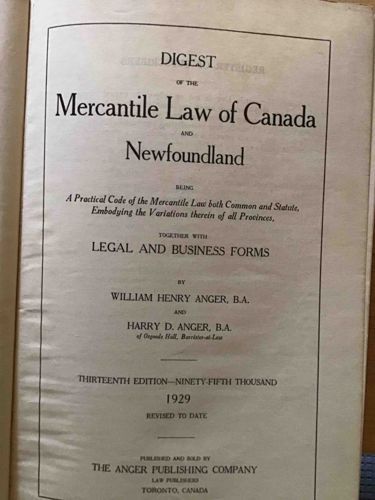
This item is the title page of a book titled "Digest of the Mercantile Law of Canada and Newfoundland," by William Henry Anger, B.A., and Harry D. Anger, B.A. It is identified as the Thirteenth Edition and Ninety-Fifth Thousand, published in 1929 and revised to date. The book was published and sold by The Anger Publishing Company, Law Publishers, located in Toronto, Canada. The title page is printed on off-white or cream-colored paper, indicative of typical book paper from the early 20th century. The text is primarily in black ink, featuring various font sizes and styles to differentiate sections, with the main title being the largest. The overall layout is well-balanced and centered. The page exhibits minimal signs of wear, consistent with the "Excellent condition" note provided. There are no apparent tears, creases, or significant discoloration. The paper appears relatively clean with very slight age-toning, which is normal for an item of this vintage. There are no visible markings, damage, or repairs on the page itself. The printing is clear and crisp, indicating good quality production, and the binding edge suggests it is part of a larger volume. The book serves as a practical code of mercantile law, including variations across Canadian provinces, and incorporates legal and business forms. Its age places it within the Interwar period, offering historical insight into Canadian and Newfoundland legal practices prior to Newfoundland's confederation with Canada.
AI Appraisal Report
Based on my examination of the provided image, which depicts the title page of the 'Digest of the Mercantile Law of Canada and Newfoundland, 13th Edition (1929)', and considering the 'Excellent condition' note, I can offer the following appraisal. The page appears to be remarkably well-preserved for its age. The off-white paper and black ink printing are consistent with early 20th-century book production. There are no visible tears, creases, or significant discoloration, with only slight age-toning, which is entirely normal. The text clarity and crispness suggest good quality printing and minimal handling before the image was taken. The overall layout is balanced and aesthetically pleasing.
From a market perspective, legal texts, even historical ones, generally have a niche market. While this particular volume offers historical insight into pre-Confederation Canadian and Newfoundland mercantile law, its demand is primarily limited to legal historians, specialized collectors of Canadiana, and potentially those interested in Newfoundland's legal history. It isn't a widely sought-after collectible in the same vein as historical maps or first editions of literary classics. Rarity is moderate; while the 'Ninety-Fifth Thousand' suggests widespread initial distribution, copies in excellent condition are less common. Factors significantly impacting value are its specific legal subject matter, the relatively low collector demand for such items compared to other genres, and its utility as a historical reference rather than a 'display piece.' The fact that it's a title page, rather than a full bound volume, can also impact value, although the condition here is exceptional for a detached page.
It is crucial to note the limitations of authenticity verification from images alone. While the visual evidence strongly supports the condition claims, I cannot definitively verify the paper's exact composition, the ink's authenticity, or detect any subtle repairs or restorations without a physical, in-person examination. For full authentication, I would require a direct inspection under magnification, potentially UV light analysis for paper and ink integrity, and assessment of the binding edge to confirm its origin from a complete volume. Provenance documentation, such as previous ownership or sale records for the complete book, would also aid in establishing its full historical context and authenticity, but this is less critical for a title page.