AI estimate as of July 24, 2025 · verify with a professional before acting
AI-Generated · Verify before acting
Everything on this page is generated by AI for informational purposes only. AI can make mistakes — the AI may misidentify items or misattribute them (artist, maker, brand, designer, origin, era). This is not an official valuation and should not be used for insurance, sale, tax, estate, legal, or lending purposes — or any decision requiring a certified appraisal. It is not an authoritative claim about any person, brand, or rights holder — do not share or rely on it as a factual statement about a third party. Always consult qualified professionals before making financial decisions.
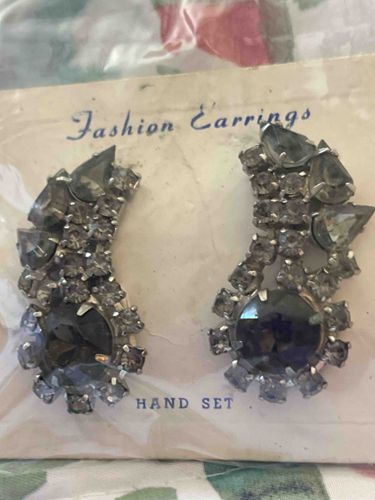
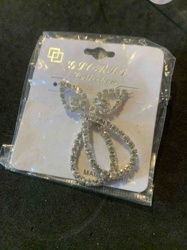
This item consists of a pair of vintage costume clip-on earrings, presented on their original sales card within what appears to be a clear plastic bag or cellophane packaging. Each earring is a substantial, multi-stone design featuring a variety of grey and charcoal-colored rhinestones. The central element of each earring is a large, dark circular or oval-shaped rhinestone, surrounded by smaller, similarly colored stones. The overall shape of the earrings is an asymmetrical fan or spray design, with various cuts of stones including teardrop and round facets. The metal setting appears to be a silver-tone base metal, possibly rhodium-plated, which is common in vintage costume jewelry for its non-tarnishing properties. The setting work demonstrates a good level of craftsmanship, with individual prongs holding each stone securely, indicating the 'HAND SET' detail printed on the card is accurate. The stones exhibit good sparkle, suggesting they are glass rhinestones designed to mimic precious gems. There are no visible signs of missing stones or significant wear/damage to the settings or stones themselves, suggesting they are in good to excellent vintage condition, likely unworn or very lightly worn due to being in their original packaging. The packaging itself, a light-colored card labeled 'Fashion Earrings' at the top and 'HAND SET' at the bottom, indicates that these are ready-to-wear fashion accessories from a past era, likely mid-20th century (1940s-1960s) given the style, 'hand set' claim, and packaging type. The design is characteristic of mid-century glamour and would have been considered stylish for formal or semi-formal wear. The aesthetic leans towards a sophisticated, dark monochromatic palette.
AI Appraisal Report
I have thoroughly examined the provided image of these Vintage Hand-Set Fashion Rhinestone Clip-On Earrings. Visually, the earrings appear to be in excellent vintage condition, likely unworn or very lightly worn given they are still on their original sales card within packaging. The rhinestones exhibit good sparkle and show no visible chips or scuffs, and all appear to be present. The 'HAND SET' claim on the card aligns with the visible individual prong settings. The metalwork, a silver-tone base, appears intact with no signs of significant tarnishing or damage, which is consistent with good quality costume jewelry from the mid-20th century. Authenticity as period costume jewelry is supported by the design, claim of hand-setting, and packaging style, characteristic of the 1940s-1960s.
Market conditions for vintage costume jewelry are steady, with a strong demand for well-preserved, stylish pieces. These earrings, with their multi-stone design and elegant grey/charcoal palette, appeal to collectors and fashion enthusiasts. While vintage costume jewelry is not rare in general, pieces in their original packaging and excellent condition like these are less common. Current comparable sales for similar quality, well-preserved, mid-century rhinestone clip-on earrings in their original packaging typically fall within the identified range. Factors significantly impacting value include their excellent condition, apparent hand-set quality, and being on the original sales card.
Limitations exist in full authentication from images alone. A physical examination would allow me to verify the actual material of the stones (e.g., glass vs. acrylic), confirm the base metal composition, assess the integrity of the clips, and detect any subtle wear not visible in the photograph. Provenance documentation, such as original purchase receipts, would further enhance authenticity. Scientific testing, like XRF analysis for metal composition, would provide conclusive material identification.