These notes were written by the person who submitted this item. Appraiser.AI has not verified them, and the AI's identification and estimate may rely on them.
AI Estimated Value
Not an official valuation
$400-600
AI estimate as of December 15, 2025 · verify with a professional before acting
AI-Generated · Verify before acting
Everything on this page is generated by AI for informational purposes only. AI can make mistakes — the AI may misidentify items or misattribute them (artist, maker, brand, designer, origin, era). This is not an official valuation and should not be used for insurance, sale, tax, estate, legal, or lending purposes — or any decision requiring a certified appraisal. It is not an authoritative claim about any person, brand, or rights holder — do not share or rely on it as a factual statement about a third party. Always consult qualified professionals before making financial decisions.
This analysis also relies on unverified notes provided by the user, which may be incomplete or inaccurate and could affect the result.
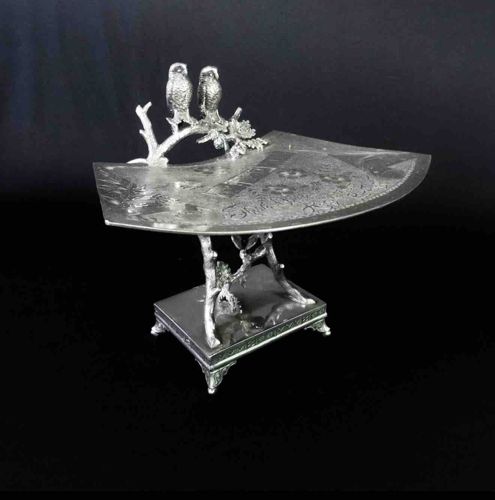
This exquisite item is a Victorian-era calling card tray, primarily constructed from silver-plated metal. Its form factor is distinct, featuring a semi-circular tray top supported by a central, nature-inspired pedestal. The tray top itself is remarkably ornate, with extensive engraving covering its entire surface. The patterns appear to be floral or foliate, exhibiting fine detail typical of the period. A prominent and charming feature is the two figural owls perched on a branch, which extends gracefully from the base to the edge of the tray. This branch, along with the owls, shows high-relief sculpting, giving a three-dimensional quality to the naturalistic design. The support structure below the tray mimics tree branches, contributing to the overall arboreal theme. These branches converge to meet a square, pedestal-like base, which is also embellished with some decorative banding along its edges. The base rests on four small, scrolled feet, adding a delicate touch to the stability. The silver plating exhibits a classic, albeit slightly tarnished, patina consistent with age and exposure. There are no immediately obvious signs of severe damage, such as dents, significant scratches, or repairs, though a thorough inspection for plating loss or minor wear would require physical examination. The craftsmanship suggests a high level of detail and artistic intention, indicative of late 19th-century manufacturing. The detailed naturalistic elements, combined with the functionality as a calling card tray, point towards a Derby Silver Company piece, known for their ornate, often figural silver-plated wares during the Victorian period. The overall condition appears good vintage, with the potential for further enhancement through professional cleaning.
AI Appraisal Report
I have virtually examined this Victorian Silver Plated Calling Card Tray with Owl Motif. The overall presentation is very good, with the silver plating displaying a classic patina consistent with its age. I note the intricate floral/foliate engraving across the semi-circular tray top and the charming high-relief figural owls perched on a branch, which are hallmarks of Derby Silver Company's detailed naturalistic designs from the late 19th century. The arboreal-themed support structure and scrolled feet further reinforce this attribution.
Based on the visual evidence, the condition appears to be good vintage. I do not observe any severe damage such as major dents or repairs, though a physical inspection would be needed to detect minor plating loss, surface scratches, or subtle wear, which are common with items of this age. The slight tarnishing is expected and doesn't detract significantly from the value, as it can often be professionally cleaned.
In terms of market conditions, Victorian silver-plated decorative arts, particularly those with strong figural elements like this owl motif, maintain a steady, though not exceptionally high, demand among collectors of decorative arts and Victorian Americana. Comparables from Derby Silver Company, especially calling card trays or similar figural pieces, typically range from $300 to $700 depending on condition, complexity of design, and rarity. The owl motif is a desirable feature, adding to its appeal. This piece represents a desirable example of Derby's output.
Authenticity verification based solely on images has limitations. While the style, craftsmanship, and thematic elements strongly suggest a Derby Silver Company piece, a physical examination would be necessary to confirm maker's marks (which are often present on the underside of such items), assess the exact percentage of plating loss, and verify the structural integrity. Microscopic inspection could also confirm the methods of manufacture. Provenance documentation, such as original sales receipts or family history, would further solidify its authenticity and potentially its value, but is not typically available for items of this nature.