AI Appraisal Estimate

AI-generated estimates · not official valuations

From the user

What was submitted

Photo and notes provided by the user — not generated by AI

Submitted item photo
Submitted photo · May 30, 2026

User's notes

No additional notes provided.

AI analysis below

AI appraisal

AI analysis & estimate

AI-Generated · Verify before acting

Everything below is generated by AI for informational purposes only. AI can make mistakes — the AI may misidentify items or misattribute them (artist, maker, brand, designer, origin, era). This is not an official valuation and should not be used for insurance, sale, tax, estate, legal, or lending purposes — or any decision requiring a certified appraisal. It is not an authoritative claim about any person, brand, or rights holder — do not share or rely on it as a factual statement about a third party. Always consult qualified professionals before making financial decisions.

Read the full disclaimer

AI Identification

·Not independently authenticated·Verify before acting

Encyclopædia Britannica Fifteenth Edition Macrophaedia Set

Books and Manuscripts

AI Estimated Value

·Not an official valuation·Verify before acting

$100.00 - $150.00

As of May 30, 2026

AI Item Analysis

·AI can make mistakes·Verify before acting
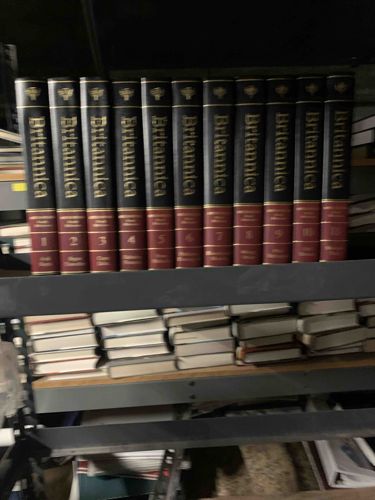
A set of twelve volumes from the Encyclopædia Britannica, specifically identified by the 'Britannica' name and the dark red and black binding scheme characteristic of the Fifteenth Edition, Macropædia section. The volumes are presented in a unified library binding, featuring a horizontal division with a deep burgundy or maroon lower section and a black upper section on the spine. The spines are embellished with gold-leaf or gilt lettering, including the title 'Britannica,' volume numbers 1 through 12, and alphabetical ranges displayed at the bottom of the red sections. Each volume displays a decorative gold thistle emblem at the top of the spine, a hallmark of the Britannica brand. The craftsmanship suggests a durable, mass-produced reference set intended for institutional or serious home library use, likely dating from the mid-1970s to the 1990s. The condition appears fair to good; while the spines show structural integrity, there is visible edge wear, slight scuffing on the corners, and minor fading of the gilt on certain volumes. This set represents the 'Knowledge in Depth' portion of the Britannica 3 system. The physical footprint of these twelve volumes suggests a heavy, large-format production using high-quality acid-neutral paper typical of premium reference sets from this era.
AI Appraisal Report

·AI can make mistakes·Verify before acting
I have examined the digital representation of this twelve-volume Macropædia set from the Encyclopædia Britannica Fifteenth Edition. The set features the iconic burgundy and black library binding with gilt lettering and thistle emblems, identifying it as part of the 'Britannica 3' system introduced in 1974. Based on my visual inspection, the set appears to be in fair to good condition. While the spines retain structural integrity, the visible edge wear and scuffing to the corners suggest frequent use or standard shelf friction over several decades. The gilt remains relatively bright, though minor fading is evident. The market for physical encyclopedias has undergone a significant decline due to the dominance of digital information. These sets are no longer valued for their updatedness but rather for their aesthetic 'shelf appeal' or as stable reference points for specific historical perspectives. Because this is only a partial set (the Macropædia section without the accompanying Micropædia, Propædia, or Yearbooks), its value is significantly lower than a complete 30+ volume collection. Comparables for partial sets typically sell within the $75 to $150 range depending on the specific year of printing. Limitations: My assessment is based solely on the provided image. I cannot verify the condition of the internal hinges, the presence of foxing or mold on the interior pages, or the presence of unwanted odors (such as tobacco or basement dampness) which are common in books of this age. A full authentication would require an in-person physical inspection of the leaf margins and binding sowings. Provenance documentation, while helpful for rare antiquarian books, is less critical for mass-produced 20th-century editions like this one.

Get your items appraised

Instant estimates of your treasures with AI-powered appraisals

Browse More Appraisals