AI estimate as of July 24, 2025 · verify with a professional before acting
AI-Generated · Verify before acting
Everything on this page is generated by AI for informational purposes only. AI can make mistakes — the AI may misidentify items or misattribute them (artist, maker, brand, designer, origin, era). This is not an official valuation and should not be used for insurance, sale, tax, estate, legal, or lending purposes — or any decision requiring a certified appraisal. It is not an authoritative claim about any person, brand, or rights holder — do not share or rely on it as a factual statement about a third party. Always consult qualified professionals before making financial decisions.
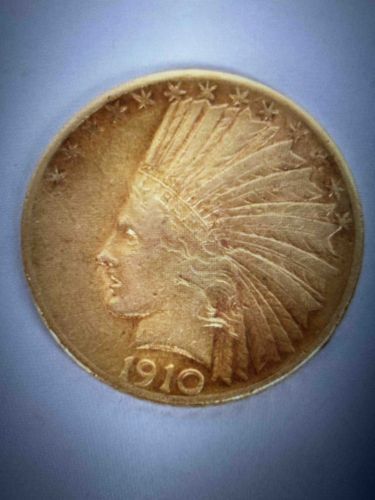
The item is a circular metal coin, appearing to be composed of gold or a gold-colored alloy, exhibiting a warm, yellowish metallic sheen with some areas of darker patina or toning, particularly visible in the recesses of the design and near the edges. The obverse features a profile portrait of an individual facing left, depicted wearing a Native American feathered headdress. The headdress is intricately detailed with numerous individual feathers radiating outwards. Above the forehead of the individual, there appears to be a smaller band or decoration on the headdress. The facial features are relatively well-preserved, showing a firm jawline, nose, and eye. Along the top circumference of the coin, several five-pointed stars are visible, possibly indicating states or a national emblem, with approximately 13 stars discernible around the upper arc of the design. The date '1910' is clearly engraved at the bottom of the coin, below the portrait. The surface shows a light to moderate level of wear consistent with circulation, with some loss of fine detail on the highest points of the relief, such as the tips of the feathers. There are no obvious deep scratches, dents, or signs of significant damage beyond typical handling and age. The luster is somewhat subdued, suggesting either original matte finish or light wear/toning. The craftsmanship appears to be of high quality, indicative of official minting, with a well-struck design and clear lettering for the date. The overall condition suggests it has been cared for, but not necessarily preserved in a pristine, uncirculated state.
AI Appraisal Report
Upon examining the provided image of this 1910 United States Indian Head Gold Coin, I observe a well-preserved specimen given its age. The warm, yellowish metallic sheen is consistent with a gold composition, and the intricate details of the feathered headdress and facial features are largely intact, indicating a good strike. The visible date '1910' is clear and legible. While there's a light to moderate level of wear, particularly on the higher points like the feather tips, this is typical for a circulated coin. There are no obvious deep scratches, dents, or significant damage, suggesting it has been handled with reasonable care. The subdued luster could indicate either an original matte finish, common for some Indian Head gold coins, or moderate circulation wear.
From a market perspective, Indian Head gold coins, especially those in better circulated grades (such as AU or lower MS), are consistently in demand due to their historical significance, artistic design, and gold content. The 1910 issue is not considered a key date, meaning its rarity is moderate compared to some other years in the series, but it remains highly collectible. Factors significantly impacting value include the precise grade (which requires in-hand examination), the presence of any mint marks (not discernible in this image), and the actual gold weight.
However, it's crucial to acknowledge the limitations of appraising from images alone. While the visible characteristics strongly suggest authenticity, definitive authentication would require a physical examination to assess the coin's weight, dimensions, edge milling, and metallic composition. Microscopic analysis could confirm strike details and detect any alterations or counterfeits. Furthermore, verifying provenance documentation, if available, would add another layer of certainty regarding its history and legitimacy. Without these in-person verifications, my assessment of authenticity is based solely on visual consistency with known genuine examples.