AI estimate as of October 7, 2025 · verify with a professional before acting
AI-Generated · Verify before acting
Everything on this page is generated by AI for informational purposes only. AI can make mistakes — the AI may misidentify items or misattribute them (artist, maker, brand, designer, origin, era). This is not an official valuation and should not be used for insurance, sale, tax, estate, legal, or lending purposes — or any decision requiring a certified appraisal. It is not an authoritative claim about any person, brand, or rights holder — do not share or rely on it as a factual statement about a third party. Always consult qualified professionals before making financial decisions.
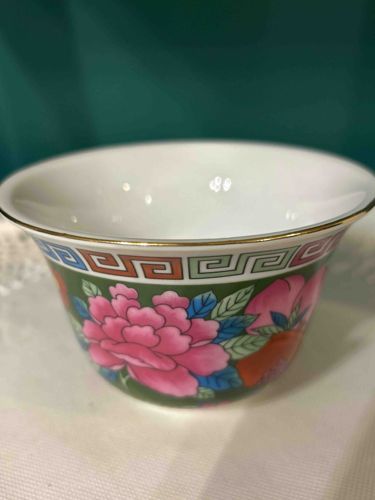
This item is a small, round porcelain bowl, likely a tea bowl or sake cup, characterized by vibrant hand-painted or transfer-printed decoration. The exterior features a rich, dark green background upon which large, opulent pink peony blossoms with blue and light green foliage are depicted. One prominent pink peony takes up a significant portion of the visible side. Above the main floral motif, there is a decorative band with a stylized geometric key pattern, commonly known as a 'meander' or 'scroll' pattern, in alternating orange, light blue, and light green on a white ground, delineated by thin black lines. The rim of the bowl is finished with a thin gold band, suggesting a touch of elegance and potentially a slightly higher quality. The interior of the bowl is a clean, glossy white, indicative of fine porcelain. The construction appears sturdy and well-formed. Given the typical use of such bowls, it is likely made from high-fired porcelain, known for its durability and translucent qualities. No visible chips, cracks, or significant wear are apparent from the image, suggesting good overall condition. The style points to an East Asian origin, possibly Chinese or Japanese, and could date from the mid-20th century to modern production, due to the clarity of the colors and general manufacturing precision often associated with more contemporary ceramics. The quality of the decoration, especially the vibrant colors and detailed floral patterns, indicates a level of craftsmanship intended for decorative or ceremonial use, or simply for everyday enjoyment given its utilitarian form.
AI Appraisal Report
Based on my visual examination of the provided image, this Asian Floral Pattern Porcelain Bowl appears to be in excellent condition. I observe no chips, cracks, or significant wear, and the gold rim looks intact. Authenticity, based solely on the image, points to an East Asian origin, likely Chinese or Japanese, dating from the mid-20th century to modern production. The vibrant colors and clear, detailed floral patterns are consistent with modern manufacturing techniques, potentially hand-painted or a high-quality transfer print. The classic 'meander' geometric band adds a traditional aesthetic.
Market conditions for such items show a broad range. While antique examples fetch higher prices, modern decorative porcelain bowls of this type, even those with intricate patterns, generally fall into the affordable collectibles category. Comparables often include similar decorative tea bowls or sake cups found in online marketplaces or antique malls. The demand for these beautiful yet common decorative wares is moderate; they are popular for collectors of Asian art or as decorative accents, but generally not rare.
Factors significantly impacting value include the excellent condition, the attractive and traditional design, and the apparent quality of execution. However, without in-person examination, I cannot definitively confirm whether the decoration is hand-painted or transfer-printed, which can affect value. A physical inspection would allow me to assess the quality of the porcelain body, any maker's marks on the base, and the true texture of the painting. Provenance documentation, though unlikely for an item of this type unless truly antique, would also add value. Scientific testing is typically not applied to items of this estimated value. Considering these factors, I would place its value in the decorative arts market at $40-75.