AI estimate as of October 5, 2025 · verify with a professional before acting
AI-Generated · Verify before acting
Everything on this page is generated by AI for informational purposes only. AI can make mistakes — the AI may misidentify items or misattribute them (artist, maker, brand, designer, origin, era). This is not an official valuation and should not be used for insurance, sale, tax, estate, legal, or lending purposes — or any decision requiring a certified appraisal. It is not an authoritative claim about any person, brand, or rights holder — do not share or rely on it as a factual statement about a third party. Always consult qualified professionals before making financial decisions.
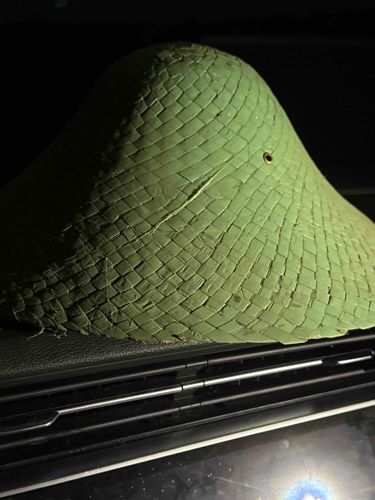
This item is a conical, woven straw hat, characterized by its distinctive green color. The material appears to be natural straw or a similar plant fiber, woven in a tight, square-patterned plait throughout the entire structure of the hat. The weaving technique results in visible, slightly raised individual strands, giving it a somewhat textured, almost scaled appearance. The color is a muted, olive-like green, which shows some fading and discoloration in various areas, suggesting exposure to elements or age. One notable feature is a single brass or gold-toned eyelet located on the side of the crown, likely intended for ventilation or for attaching a chin strap. The overall shape is a classic conical form, wide at the base and tapering upwards to a rounded peak. The condition exhibits signs of wear, including several cracks or breaks in the woven material, particularly noticeable on the top and side of the crown. There are also visible areas where the green color has chipped or worn away, revealing a lighter, possibly natural straw color underneath. The edges of the hat, particularly where it rests on the surface, show additional fraying and wear. This type of hat is commonly associated with traditional East Asian agricultural practices or protective headwear. Given its construction and apparent wear, it is likely a vintage or antique piece, possibly dating from the mid-20th century or earlier. The craftsmanship is utilitarian, focused on function over elaborate decoration, indicative of a durable working hat.
AI Appraisal Report
Based on my visual examination of the provided image, this Green Woven Straw Conical Hat appears to be an authentic example of traditional East Asian protective headwear. The weaving technique, visible square-patterned plait, and overall utilitarian design are consistent with such items. Its muted, olive-like green color, along with visible fading, discoloration, and worn areas, strongly suggests age and genuine use, rather than an artificial distressed look. The single brass or gold-toned eyelet further supports its functional origins, likely for ventilation or a chin strap.
Regarding condition, I assess it as fair to poor. There are noticeable cracks and breaks in the woven material, particularly on the crown, and significant chipping and wear of the green color, revealing lighter straw underneath. The fraying edges also indicate considerable use and age. These factors, while contributing to its 'vintage' appeal, detract from its overall structural integrity and aesthetic value to a degree.
In terms of market conditions, items such as this are generally considered decorative or cultural artifacts rather than high-value collectibles unless they possess significant historical provenance or exceptional craftsmanship. Demand exists primarily within niche markets of collectors of ethnographic items, folk art, or specific Asian cultural artifacts. Rarity is moderate; while many such hats were produced, examples in this specific condition and age are less common but not exceedingly rare.
Key factors impacting its value are its discernible age, the authentic wear and tear (which can be desirable for historical context), and its cultural association. However, the signs of damage, such as cracks and significant wear, are the primary limiting factors on its appraisal value. The lack of specific provenance documentation (e.g., origin, date of manufacture, previous ownership) also prevents a higher valuation.
It is crucial to note that this appraisal is based solely on visual evidence from the image. For full authentication and a more precise valuation, an in-person examination would be necessary to assess the precise material composition, weight, internal condition, and to identify any subtle repairs or inconsistencies missed in photographs. Scientific testing could confirm the age of the materials, and provenance documentation (if available) would be paramount in determining any historical significance that could significantly elevate its value beyond a decorative item.