AI Appraisal Estimate

AI-generated estimates · not official valuations

From the user

What was submitted

Photo and notes provided by the user — not generated by AI

Submitted item photo
Submitted photo · May 18, 2026

User's notes

Framed Gustav Klimt print

AI analysis below

AI appraisal

AI analysis & estimate

AI-Generated · Verify before acting

Everything below is generated by AI for informational purposes only. AI can make mistakes — the AI may misidentify items or misattribute them (artist, maker, brand, designer, origin, era). This is not an official valuation and should not be used for insurance, sale, tax, estate, legal, or lending purposes — or any decision requiring a certified appraisal. It is not an authoritative claim about any person, brand, or rights holder — do not share or rely on it as a factual statement about a third party. Always consult qualified professionals before making financial decisions.

Note

This analysis also relies on unverified notes provided by the user, which may be incomplete or inaccurate and could affect the result.

Read the full disclaimer

AI Identification

·Not independently authenticated·Verify before acting

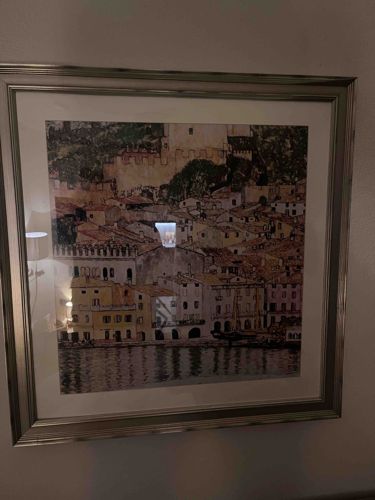
Framed Print of 'Malcesine on Lake Garda' by Gustav Klimt

Wall Art & Decor

AI Estimated Value

·Not an official valuation·Verify before acting

$150-$250

As of May 18, 2026

AI Item Analysis

·AI can make mistakes·Verify before acting
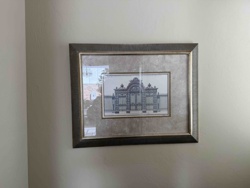
This item is a large-format reproduction print of the 1913 oil painting 'Malcesine on Lake Garda' (Malcesine am Gardasee) by Austrian symbolist painter Gustav Klimt. The artwork depicts a dense, mosaic-like arrangement of Italian architecture along a waterfront, characterized by Klimt's unique square-format composition and flattened perspective. The color palette features earthy ochres, whites, and muted greens, reflecting the light of Northern Italy. Physically, the print is housed under glass within a contemporary metallic-finished frame, likely wood or high-density composite with a brushed silver or champagne-gold fluted profile. The print is professionally set within a wide, off-white archival-style mat board that provides a significant border, enhancing its presence. While the original painting was tragically destroyed in 1945, this modern lithographic or giclee reproduction captures the detailed textures and geometric patterns of the original work. The framing appears to be in good modern condition, though minor surface dust is visible on the glass and frame edges. There are no visible signs of foxing or UV fading on the print itself from the current angle. This piece represents the Secessionist style of the early 20th century, frequently reproduced for interior design purposes in the late 20th and early 21st centuries.

AI Appraisal Report

·AI can make mistakes·Verify before acting
I have conducted a visual examination of this large-format framed print of Gustav Klimt's 'Malcesine on Lake Garda.' Based on my assessment, this is a modern commercial reproduction, likely a giclée or high-quality offset lithograph. The original 1913 oil painting was destroyed by fire at Schloss Immendorf in 1945; therefore, any existing version of this image is by necessity a post-war reproduction and carries no 'original' fine art value beyond its decorative utility or the quality of the print run. The condition appears excellent with no visible UV fading or moisture damage, and the professional archival matting adds significant decorative appeal. The market for Klimt reproductions is robust but saturated. Comparables for such pieces in retail decor galleries or secondary markets like estate sales generally range between $100 and $300, depending largely on the quality of the framing. This specific piece features a contemporary fluted metallic frame that appears to be in good condition, which accounts for the majority of the current valuation. The 'Secessionist' style remains popular in interior design, ensuring steady demand. Limitations of this appraisal include the inability to inspect the paper stock for watermarks or determine if the print is a limited edition, as the lower margin is obscured by the matting. I cannot verify the framing materials (wood vs. composite) or the glass type (standard vs. UV-protective) without physical handling. A full authentication would require removing the print from the frame to inspect for publisher stamps, edition numbers, or copyright dates on the verso. For insurance purposes, this should be considered a decorative asset rather than a fine art investment.

Get your items appraised

Instant estimates of your treasures with AI-powered appraisals

Browse More Appraisals