AI estimate as of October 1, 2025 · verify with a professional before acting
AI-Generated · Verify before acting
Everything on this page is generated by AI for informational purposes only. AI can make mistakes — the AI may misidentify items or misattribute them (artist, maker, brand, designer, origin, era). This is not an official valuation and should not be used for insurance, sale, tax, estate, legal, or lending purposes — or any decision requiring a certified appraisal. It is not an authoritative claim about any person, brand, or rights holder — do not share or rely on it as a factual statement about a third party. Always consult qualified professionals before making financial decisions.
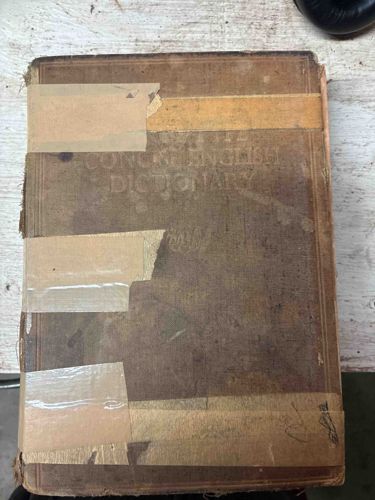
This item is an antique English dictionary, likely from the late 19th or early 20th century, based on its physical characteristics and apparent style. The dictionary features a hardbound cover, dark brown in color, which appears to be made of cloth or a textured paper material, simulating a more substantial binding. The front cover clearly displays the embossed or debossed title: 'THE CONCISE ENGLISH DICTIONARY!', although parts of the lettering are obscured by repairs. The typography suggests an older print style. There are significant visible condition issues, notably several large strips of tan-colored tape, possibly masking tape or similar adhesive, applied horizontally across the cover. These repair attempts cover large portions of the text and the cover's surface, indicating prior damage such as tears or separating binding. The corners and edges of the book are heavily worn, with fraying and loss of material, particularly on the top left and bottom right corners. The original surface texture of the cover is largely obscured by dirt, grime, and the adhesive residue from the tape. The spine of the book is not clearly visible but appears to be part of the continuous, somewhat uniform brown tone of the cover, suggesting a utilitarian rather than ornate binding. There are no immediate visible maker's marks, signatures, or specific publishing stamps discernible from the image. The overall appearance points to a well-used and aged volume, likely handled frequently throughout its lifespan, leading to its current state of significant wear and amateur repairs. The quality of its original craftsmanship, while difficult to ascertain fully due to condition, appears to have been sturdy enough to withstand considerable use, even if the present state reflects neglect and expediency in repairs.
AI Appraisal Report
Upon examining the provided image of 'THE CONCISE ENGLISH DICTIONARY!', I assess this item to be an antique English dictionary, likely dating from the late 19th or early 20th century. Its authenticity as a period dictionary is supported by the typography and general style consistent with that era. However, its condition is extremely poor. The hardbound cover, likely cloth or textured paper, exhibits severe wear, fraying, and loss of material, particularly at the corners and edges. Crucially, multiple strips of tan-colored tape, indicative of amateur repairs, obscure significant portions of the title and cover surface. This suggests extensive prior damage such as tears or a failing binding. The surface is also marred by dirt, grime, and adhesive residue.
Market conditions for common antique dictionaries in such a distressed state are very low. Comparables typically involve dictionaries of significant rarity (e.g., first editions of influential works) or those in at least 'good' to 'very good' condition. This particular dictionary lacks any apparent distinguishing features that would bestow rarity. There is virtually no demand for heavily damaged, common dictionaries among collectors, who prioritize condition and often look for unique bindings, historical significance, or notable publishers. The extensive visible damage and amateur repairs are significant negative factors impacting value. Without knowing the publisher or specific edition beyond the generic title, it is difficult to ascertain any inherent value beyond its identity as an old book.
My assessment of authenticity is limited to visual characteristics; without an in-person examination, I cannot verify the paper quality, printing methods, or internal completeness. Full authentication would require physical inspection to assess the binding's original construction, paper quality, printing techniques, and to check for any hidden marks or inscriptions. Provenance documentation would also be crucial to establish any unique history. Scientific testing, while possible, is not warranted for an item of this type and condition given its low market value.