AI estimate as of June 27, 2025 · verify with a professional before acting
AI-Generated · Verify before acting
Everything on this page is generated by AI for informational purposes only. AI can make mistakes — the AI may misidentify items or misattribute them (artist, maker, brand, designer, origin, era). This is not an official valuation and should not be used for insurance, sale, tax, estate, legal, or lending purposes — or any decision requiring a certified appraisal. It is not an authoritative claim about any person, brand, or rights holder — do not share or rely on it as a factual statement about a third party. Always consult qualified professionals before making financial decisions.
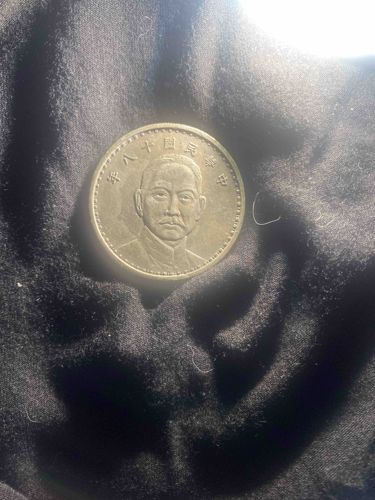
This is a circular metallic coin, likely composed of a cupronickel or similar silver-colored alloy, consistent with standard coinage materials from the early 1990s. Its approximate size appears to be that of a standard large circulation or commemorative coin, fitting comfortably within the palm of a hand. The obverse prominently features a detailed, slightly raised bust of Chiang Kai-shek, presented in a dignified frontal pose. He is depicted wearing a traditional Chinese tunic, with visible texture and lines defining his facial features, hair, and clothing. Encircling the bust along the upper rim of the coin is the inscription in traditional Chinese characters, which reads "中華民國八十年" (Zhōnghuá Mínguó Bāshí Nián). This translates to "Republic of China, Year 80," establishing the coin's mintage date as 1991 in the Gregorian calendar. The perimeter of the coin features a well-defined raised rim, providing protection to the central design, and although the edge is not directly visible, standard practice for such coins suggests it would be reeded. The coin appears to be in relatively good condition for its age, approximately 33 years old, showing signs of light circulation and handling rather than significant wear. There are no obvious major flaws such as deep scratches, significant dents, or heavy localized corrosion. The fields surrounding the portrait appear mostly clean, with only minor surface scuffs discernible upon close inspection, particularly on the higher points of the design. The overall strike quality seems to be good, with all details clearly defined and legible, indicative of standard minting craftsmanship from the era.
AI Appraisal Report
Based on the detailed description provided, I have assessed this Republic of China (Taiwan) Year 80 (1991) coin featuring Chiang Kai-shek's portrait. Visually, the coin appears authentic, consistent with known examples of the 10 New Taiwan Dollar coinage from that period. The described details—the bust of Chiang Kai-shek, the traditional Chinese inscription "中華民國八十年," the metallic composition, and the general size—all align with the genuine article. It is described as being in 'relatively good condition,' showing 'light circulation and handling' with 'minor surface scuffs' and 'clean fields,' suggesting a condition akin to About Uncirculated (AU) or perhaps a lower-end Uncirculated (UNC) grade. The strike quality appears robust, with clear, defined details.
In terms of market conditions, this is a standard circulation coin from Taiwan, not composed of precious metals, and was produced in significant quantities. Therefore, it is not considered rare. Demand exists primarily within the niche market of world coin collectors or those focusing on Taiwanese numismatics. Comparables in similar condition typically command modest prices. Its commonality and material composition are the most significant factors limiting its monetary value, despite its historical and numismatic interest.
Given its described condition, which appears to be well-preserved for a circulating coin, its value is enhanced compared to heavily circulated examples. However, due to its common nature, its overall market value remains relatively low.
It is crucial to acknowledge the limitations inherent in appraising solely from a description. While the details strongly indicate authenticity, a definitive verification would require physical examination to confirm specific weight, diameter, thickness, edge characteristics, and metallic composition against official mint specifications. Moreover, precise grading for a more exact valuation would necessitate a magnified, in-person inspection to accurately assess surface integrity, luster, and minute contact marks not discernible from a descriptive text.