These notes were written by the person who submitted this item. Appraiser.AI has not verified them, and the AI's identification and estimate may rely on them.
AI Estimated Value
Not an official valuation
$40-80
AI estimate as of September 20, 2025 · verify with a professional before acting
AI-Generated · Verify before acting
Everything on this page is generated by AI for informational purposes only. AI can make mistakes — the AI may misidentify items or misattribute them (artist, maker, brand, designer, origin, era). This is not an official valuation and should not be used for insurance, sale, tax, estate, legal, or lending purposes — or any decision requiring a certified appraisal. It is not an authoritative claim about any person, brand, or rights holder — do not share or rely on it as a factual statement about a third party. Always consult qualified professionals before making financial decisions.
This analysis also relies on unverified notes provided by the user, which may be incomplete or inaccurate and could affect the result.
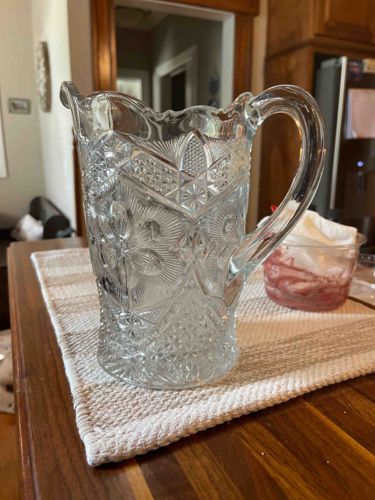
This is a clear pressed glass water pitcher, exhibiting a classic design with intricate patterns. The pitcher features a prominent handle, likely applied, demonstrating a graceful curve that extends from below the rim to just above the base. The rim itself is scalloped or undulating, adding a decorative flourish. The body of the pitcher is adorned with a complex pressed glass design, characterized by a series of geometric and floral motifs. Elements observable include diamond point patterns, hobnail-like textures, and stylized starburst or flower patterns (some appearing to be four-petaled or radiating from a central point), all deeply cut and highly reflective, suggesting quality craftsmanship. The base appears to be solid and somewhat thickened, also incorporating a pressed design, likely a continuation of the lower body pattern or a distinct but complementary motif. The glass is transparent and free of obvious discoloration, though specific clarity cannot be fully assessed without additional lighting. There are no readily apparent significant chips, cracks, or repairs visible in the provided images, though minor surface wear or scratches common with age and use may be present but are not discernible. The manufacturing technique is clearly pressed glass, which became very popular from the mid-19th century onwards due to its ability to produce highly decorative items at a more affordable price than cut glass. Based on the intricate and somewhat busy pattern styles, it likely dates from the late 19th to early 20th century, possibly within the American Brilliant Period or shortly after, capitalizing on similar aesthetic trends but utilizing the pressed glass method. Its 32 oz capacity suggests it is intended for serving beverages like water, iced tea, or juice.
AI Appraisal Report
Based on my visual examination of the provided image, this clear pressed glass water pitcher, with its 32 oz capacity, appears to be in very good condition. I could not discern any significant chips, cracks, or repairs, though minor surface wear or scratches are common with age and use and might not be visible in images. The manufacturing technique is clearly pressed glass, which, as noted, allowed for intricate designs at a more affordable price than cut glass. The design, featuring diamond point, hobnail-like textures, and stylized starburst/floral motifs, is characteristic of late 19th to early 20th-century American production. The applied handle is a typical feature of this period.
Market conditions for pressed glass items, while showing consistent interest among collectors, particularly for complete sets or rare patterns, generally place individual pitchers in a moderate value range. Comparables in similar patterns and conditions typically sell for between $30 and $100. Demand is steady but not exceptionally high for common pressed glass patterns. This particular design doesn't immediately strike me as exceedingly rare, contributing to its accessible valuation. The main factors impacting value are its condition and the intricate, appealing pattern. Its functionality as a serving piece also adds to its desirability.
It is crucial to note that this appraisal is based solely on visual inspection of images. Authenticity and exact condition verification would greatly benefit from an in-person examination. This would allow me to feel for any hairline cracks, subtle chips, or repairs, and assess glass clarity and potential haziness which are difficult to ascertain from photographs. Furthermore, proper attribution to a specific manufacturer or pattern name, which can sometimes increase value, would ideally require comparing it to known pressed glass catalogs or patterns, which is outside the scope of image-based appraisal.