AI Appraisal Estimate

AI-generated estimates · not official valuations

From the user

What was submitted

Photo and notes provided by the user — not generated by AI

Submitted item photo
Submitted photo · June 6, 2026

User's notes

Oil, painting on canvas, unknown artists

AI analysis below

AI appraisal

AI analysis & estimate

AI-Generated · Verify before acting

Everything below is generated by AI for informational purposes only. AI can make mistakes — the AI may misidentify items or misattribute them (artist, maker, brand, designer, origin, era). This is not an official valuation and should not be used for insurance, sale, tax, estate, legal, or lending purposes — or any decision requiring a certified appraisal. It is not an authoritative claim about any person, brand, or rights holder — do not share or rely on it as a factual statement about a third party. Always consult qualified professionals before making financial decisions.

Note

This analysis also relies on unverified notes provided by the user, which may be incomplete or inaccurate and could affect the result.

Read the full disclaimer

AI Identification

·Not independently authenticated·Verify before acting

Abstract Expressionist Hillside Landscape

Fine Art - Paintings

AI Estimated Value

·Not an official valuation·Verify before acting

$600 - $900

As of June 6, 2026

AI Item Analysis

·AI can make mistakes·Verify before acting
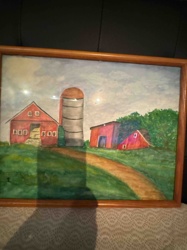
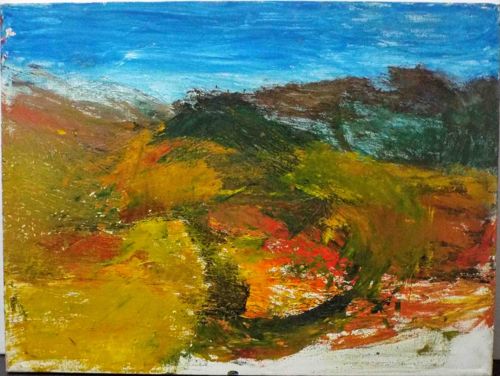
This artwork is an original oil painting on canvas featuring an abstract expressionist landscape. The composition focuses on a rolling hillside or valley, characterized by a vibrant and gestural application of paint. The palette is dominated by autumnal earth tones including mustard yellow, burnt ochre, sienna, and deep forest green, contrasted against a bright cerulean and white sky. The artist utilized heavy impasto and visible brushstrokes to create a sense of movement and texture throughout the foreground and midground. The work appears to be executed on a standard rectangular canvas with visible white priming along the bottom edge where the pigment thins. There is no visible signature or maker's mark on the front surface, consistent with the provided context of an unknown artist. The style suggests a mid-to-late 20th-century influence, emphasizing emotional response over topographical accuracy. The condition shows some minor surface scuffing and thinning of paint at the extreme edges, but the canvas remains taut. The craftsmanship exhibits a confident, rapid execution typical of plein air or intuitive studio abstraction, with significant depth created through the layering of opaque and semi-translucent oil pigments.


AI Appraisal Report

·AI can make mistakes·Verify before acting
I have carefully examined the provided high-resolution imagery of this abstract expressionist landscape. The painting exhibits a robust command of the oil medium, specifically through the use of impasto and gestural brushwork that suggests a mid-20th-century aesthetic. The condition appears fair to good; the surface shows expected aging with minor edge scuffing, though the lack of craquelure suggests the pigment remains relatively flexible and stable. In the current decorative market, unsigned original oils from this period are valued primarily on their aesthetic merit and 'wall power.' The autumnal palette and energetic composition are currently in demand for mid-century modern interior design schemes. However, the lack of a visible signature or provenance significantly limits its value as a fine art investment. Comparables for unsigned 20th-century abstractions of this size typically fetch between $500 and $1,200 at regional auctions. The absence of historical context or a recognized hand places this work firmly in the category of 'anonymous decorative fine art.' Limitations: My assessment is based solely on digital images. A physical inspection is required to verify the canvas age, detect any previous restoration under UV light, and confirm the stability of the paint layers. To achieve a definitive authentication or higher valuation, one would need to provide provenance (history of ownership), exhibition records, or archival research to identify the artist. Furthermore, scientific testing of the pigment binders and canvas fibers would be necessary to confirm the exact decade of origin. Without these elements, the value remains tied to decorative appeal rather than art-historical significance.

Get your items appraised

Instant estimates of your treasures with AI-powered appraisals

Browse More Appraisals