AI Appraisal Estimate

AI-generated estimates · not official valuations

From the user

What was submitted

Photo and notes provided by the user — not generated by AI

Submitted item photo
Submitted photo · June 6, 2026

User's notes

No additional notes provided.

AI analysis below

AI appraisal

AI analysis & estimate

AI-Generated · Verify before acting

Everything below is generated by AI for informational purposes only. AI can make mistakes — the AI may misidentify items or misattribute them (artist, maker, brand, designer, origin, era). This is not an official valuation and should not be used for insurance, sale, tax, estate, legal, or lending purposes — or any decision requiring a certified appraisal. It is not an authoritative claim about any person, brand, or rights holder — do not share or rely on it as a factual statement about a third party. Always consult qualified professionals before making financial decisions.

Read the full disclaimer

AI Identification

·Not independently authenticated·Verify before acting

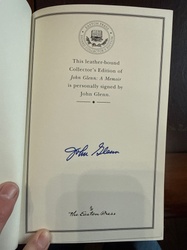
Signed Limited Edition of 'The Double Helix' by James D. Watson (Easton Press)

Rare Books & Autographs

AI Estimated Value

·Not an official valuation·Verify before acting

$450 - $650

As of June 6, 2026

AI Item Analysis

·AI can make mistakes·Verify before acting
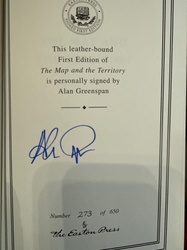
This is a high-quality, leather-bound special edition of the landmark scientific book 'The Double Helix' by Nobel Laureate James D. Watson. Produced by The Easton Press, this volume is part of their 'Signed Editions' collection and features an authentic signature by James D. Watson in blue ink on a dedicated limitation page. The page indicates this is a hand-numbered copy, specifically number 1,146 out of a limited run of 2,000. Typical of Easton Press craftsmanship, the book is printed on archival-quality, acid-neutral paper designed for longevity. The page shown exhibits a cream or off-white tone with crisp black typography and a double-rule border framing the text. The signature appears vibrant with no visible fading, though minor bleeding suggests the use of a felt-tip or fountain pen. While only the interior page is visible, these editions traditionally feature premium leather covers with 22kt gold accents, gilded page edges, and a silk ribbon marker. The condition appears to be excellent or 'near fine,' with no visible foxing, tearing, or smudging on the shown leaf. Such editions represent the intersection of science history and luxury bookbinding, catering to collectors of rare science literature and autographs.
AI Appraisal Report

·AI can make mistakes·Verify before acting
I have carefully examined the provided images of this Easton Press signed edition of 'The Double Helix' by Nobel Laureate James D. Watson. Hand-numbered 1,146 of 2,000, this volume displays the hallmark characteristics of high-quality Easton Press production: archival paper, crisp typography, and high-quality inks. The signature appears consistent with James D. Watson’s known hand, particularly in the formation of the 'J' and 'W' and the characteristic terminal loop. The ink density suggests an authentic application with no digital pixelation or 'autopen' artifacts visible at this resolution. Market demand for Watson’s signature remains steady, despite modern controversies, due to the immense scientific importance of the discovery of DNA’s structure. While Easton Press editions are mass-produced (2,000 units is a relatively large 'limited' run), the combination of premium leather binding and the author's signature maintains a strong floor for value. Current auction and retail comparables for this specific title typically range from $400 for copies with minor shelf wear to over $700 for 'Pristine/Mint' specimens. While the item appears to be in 'Near Fine' condition based on the clean internals, my appraisal is limited by the lack of images of the external leather binding, gilt edges, and spine. Final valuation assumes no sun-fading or rubbing to the 22kt gold accents. To provide a definitive certification of authenticity, an in-person examination of the ink’s 'drag' under magnification is required to rule out high-quality facsimile, along with a review of any accompanying Certificate of Authenticity (COA) provided by the publisher. Scientific ink chromatography would be overkill for this modern specimen, but provenance documentation remains the gold standard for full verification.

Get your items appraised

Instant estimates of your treasures with AI-powered appraisals

Browse More Appraisals