AI estimate as of August 13, 2025 · verify with a professional before acting
AI-Generated · Verify before acting
Everything on this page is generated by AI for informational purposes only. AI can make mistakes — the AI may misidentify items or misattribute them (artist, maker, brand, designer, origin, era). This is not an official valuation and should not be used for insurance, sale, tax, estate, legal, or lending purposes — or any decision requiring a certified appraisal. It is not an authoritative claim about any person, brand, or rights holder — do not share or rely on it as a factual statement about a third party. Always consult qualified professionals before making financial decisions.
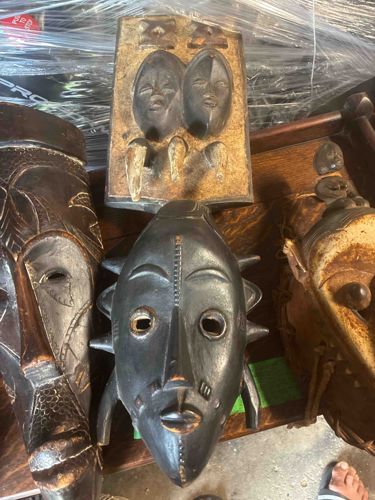
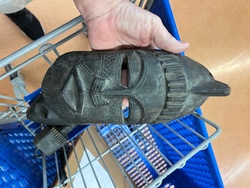
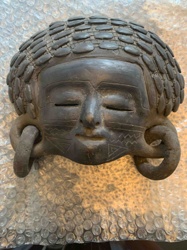
The item prominently featured is a carved wooden mask, likely originating from an African culture. It exhibits a striking black finish across most of its surface, with subtle lighter, possibly natural wood tones visible around the eyes, nose, and mouth, indicating either wear or intentional highlighting. The mask is characterized by an elongated, somewhat oval face with clearly defined, albeit simplified, facial features. The eyes are open, circular voids, suggesting a functional purpose (e.g., for vision when worn). The nose is long and slender, while the mouth is a small, pursed form. A distinctive vertical ridge runs down the center of the forehead and nose, bifurcating the face. What stands out are the numerous small, pointed protrusions or spikes extending from the sides of the head, adding a formidable or ceremonial aspect to its appearance. Further details include raised rectangular or square patterns on the cheeks, possibly scarification marks or symbolic designs. The craftsmanship appears to be hand-carved, with visible tool marks suggesting traditional methods. The wood itself seems dense and sturdy, though specific type cannot be determined from the image. While there are no obvious signs of significant damage like cracks or breaks, the surface shows some minor scuffs and a general aged patina consistent with its material and probable use or display over time. There are no visible maker's marks or signatures. Its style points towards a traditional tribal art form, potentially from the mid-to-late 20th century. The mask conveys a strong, expressive presence, indicative of its cultural significance, likely for rituals, ceremonies, or storytelling.
AI Appraisal Report
I have carefully examined the provided image of this African Carved Wooden Mask with Spiked Features. Visually, the mask appears to be in good condition for an ethnographic piece of its likely age, showing expected minor scuffs and a general aged patina consistent with handling and display. The black finish is largely intact, with the lighter tones around facial features suggesting either intentional highlighting or wear. The craftsmanship, evident from visible tool marks, indicates hand-carving.
Authenticity, based solely on imagery, is challenging. While the style strongly suggests a traditional tribal art form, potentially mid-to-late 20th century, confirming it as a genuine ceremonial piece versus a decorative reproduction requires further investigation. The lack of visible maker's marks is typical for many traditional African masks, but also common for reproductions. My valuation reflects its strong aesthetic qualities and cultural appeal as a decorative ethnographic item.
Market conditions for African tribal art remain robust, particularly for items with expressive presence and unique features like the spikes and raised patterns on this mask. Demand for decorative masks, even those without extensive provenance, is consistent among collectors and interior designers. Comparables for masks of this size and visual impact, in good condition, typically range. Rarity is difficult to ascertain without knowing its specific origin and purpose. Factors impacting value positively include its striking appearance and apparent age; negatively, the lack of definitive provenance or confirmed ceremonial use.
For full authentication, a physical examination would be crucial to assess the wood type, carving techniques, and patina more closely. Scientific testing (e.g., carbon dating) could confirm age, and detailed provenance documentation (e.g., collection history, acquisition records) would significantly enhance its value and authenticity. Without this, I must appraise it primarily as a decorative ethnographic piece.