AI Appraisal Estimate

AI-generated estimates · not official valuations

From the user

What was submitted

Photo and notes provided by the user — not generated by AI

Submitted item photo
Submitted photo · June 28, 2026

User's notes

No additional notes provided.

AI analysis below

AI appraisal

AI analysis & estimate

AI-Generated · Verify before acting

Everything below is generated by AI for informational purposes only. AI can make mistakes — the AI may misidentify items or misattribute them (artist, maker, brand, designer, origin, era). This is not an official valuation and should not be used for insurance, sale, tax, estate, legal, or lending purposes — or any decision requiring a certified appraisal. It is not an authoritative claim about any person, brand, or rights holder — do not share or rely on it as a factual statement about a third party. Always consult qualified professionals before making financial decisions.

Read the full disclaimer

AI Identification

·Not independently authenticated·Verify before acting

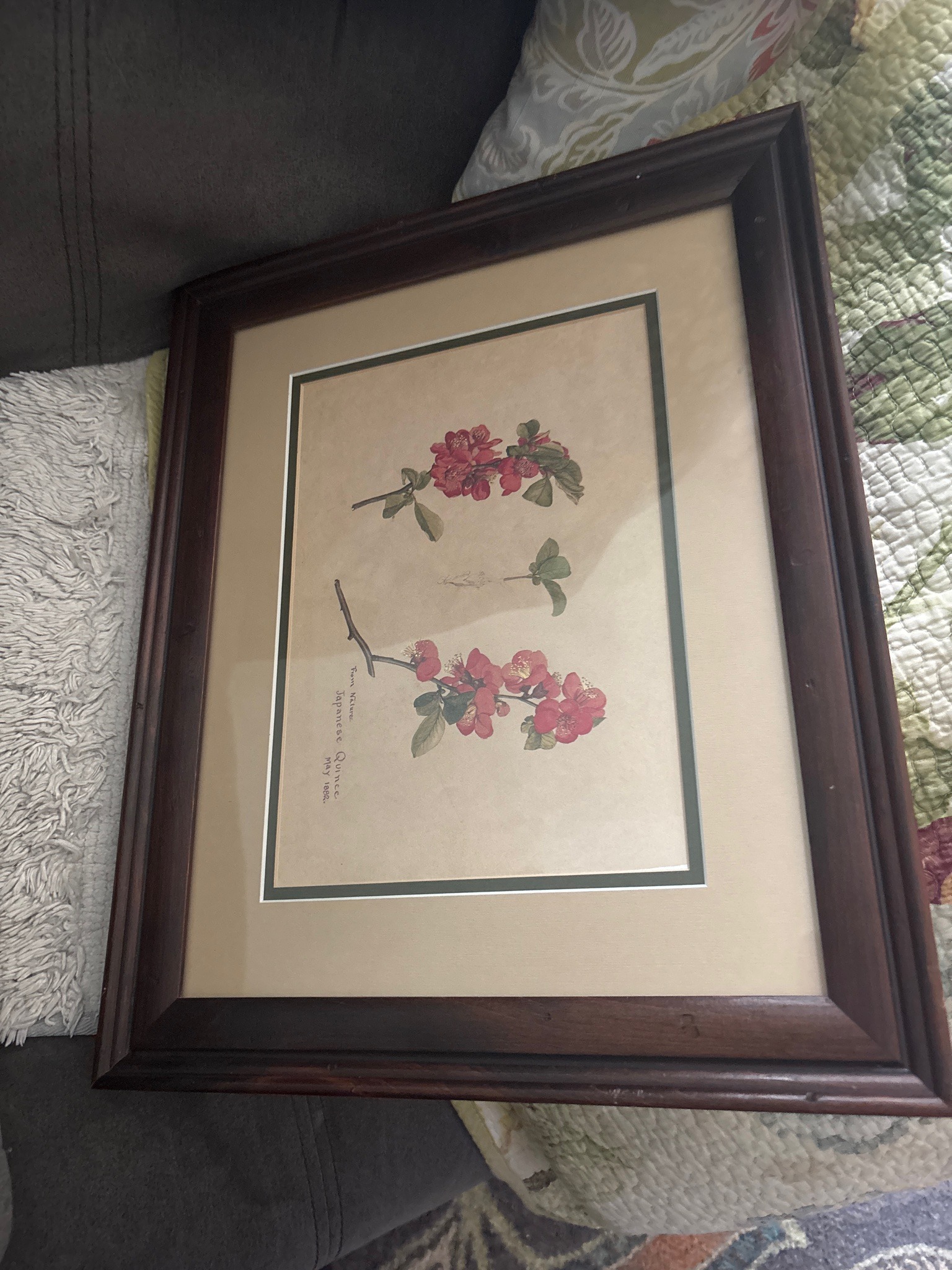
Framed Botanical Illustration of Japanese Quince

Fine Art / Botanical Prints

AI Estimated Value

·Not an official valuation·Verify before acting

$350 - $550

As of June 28, 2026

AI Item Analysis

·AI can make mistakes·Verify before acting
This is a matted and framed botanical illustration depicting two flowering branches of a Japanese Quince (Chaenomeles). The artwork features delicate reddish-pink blossoms with visible yellow stamens and small green leaves, rendered with careful attention to botanical detail. Hand-written calligraphy on the lower left side identifies the subject as 'From Nature / Japanese Quince / May 1888', suggesting it is a late Victorian-era piece likely created by an amateur or professional naturalist. The illustration is set within a double mat board; the inner mat has a dark green bevel which provides a contrast against the primarily cream-colored paper and outer mat. The frame is a substantial, dark-toned wood with a traditional beveled profile and visible wood grain. Regarding condition, the paper displays a mild age-related patina with slight yellowing and a few minor spots of foxing. The wooden frame shows light surface wear and minor scuffing consistent with its age, but remains structurally sound. The craftsmanship reflects typical late 19th-century scientific illustration styles, prioritizing accuracy and naturalistic representation.
AI Appraisal Report

·AI can make mistakes·Verify before acting
I have examined the digital representation of this framed botanical illustration of Japanese Quince (Chaenomeles). Dated May 1888, the piece is a characteristic example of the late Victorian naturalist tradition. The execution shows high technical proficiency, with delicate stippling and color layering suggestive of watercolor and gouache. The presence of foxing and mild acidification of the paper is consistent with late 19th-century cellulose-based papers, supporting its period origin. The substantial wood frame and double matting are modern additions that enhance displayability but do not contribute significantly to the antique value. Market demand for botanical art remains steady, particularly for signed or dated original works over mass-produced lithographs. Comparables for anonymous but dated 19th-century botanical studies of this quality typically realize between $300 and $600 at regional auctions. The specific identification of the Japanese Quince—a popular ornamental shrub of the era—increases its decorative appeal. Factors limiting value include the lack of a known artist's signature and the visible foxing, which may require professional conservation to prevent further degradation. Limitations: This appraisal is based solely on visual photographic evidence. A physical inspection is required to confirm the medium (e.g., to ensure it is not a high-quality chromolithograph), verify if the foxing is active mold, and inspect the paper’s watermark. Definitive authentication would require removing the work from the frame to examine the verso for further inscriptions or provenance marks. For institutional insurance purposes, scientific testing of the pigment composition would be necessary to confirm the 1888 date.

Get your items appraised

Instant estimates of your treasures with AI-powered appraisals

Browse More Appraisals