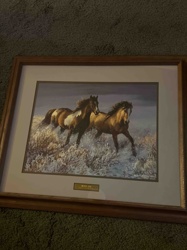
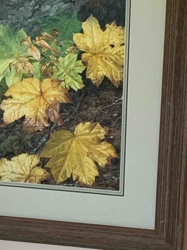
These notes were written by the person who submitted this item. Appraiser.AI has not verified them, and the AI's identification and estimate may rely on them.
AI Estimated Value
Not an official valuation
$50 - $100
AI estimate as of July 22, 2025 · verify with a professional before acting
AI-Generated · Verify before acting
Everything on this page is generated by AI for informational purposes only. AI can make mistakes — the AI may misidentify items or misattribute them (artist, maker, brand, designer, origin, era). This is not an official valuation and should not be used for insurance, sale, tax, estate, legal, or lending purposes — or any decision requiring a certified appraisal. It is not an authoritative claim about any person, brand, or rights holder — do not share or rely on it as a factual statement about a third party. Always consult qualified professionals before making financial decisions.
This analysis also relies on unverified notes provided by the user, which may be incomplete or inaccurate and could affect the result.
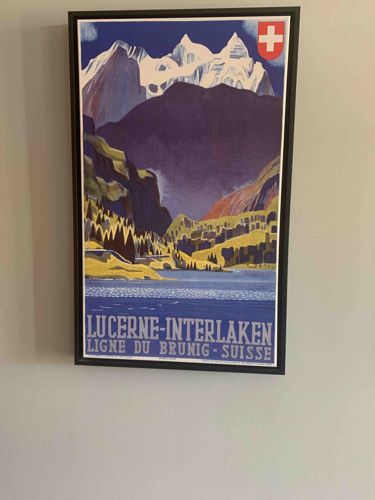
This item is a framed art print, specifically a travel poster, depicting a scenic landscape of Switzerland. The print is contained within a simple, sleek black frame, which appears to be made of wood or a composite material, providing a clean border to the artwork. The print features a vibrant and illustrative style common to vintage travel posters. The primary colors employed are deep blues for the sky and water, various shades of purple and grey for the large, snow-capped mountains, and earthy greens and yellows for the foreground hills and scattered trees. The composition includes prominent white, rugged mountain peaks in the background, subtly transitioning to lower, greener hills that frame a large body of water, likely a lake. The lake's surface is rendered with horizontal blue lines suggesting ripples or reflections. Below the central image, the text "LUCERNE-INTERLAKEN" is clearly visible in a large, sans-serif font, indicating the locations depicted or advertised. Below this, smaller text reads "LIGNE DU BRUNIG - SUISSE," which translates to "Brunig Line - Switzerland," further confirming the geographical context and suggesting a railway route. In the upper right corner, a small, distinct Swiss flag (red square with a white cross) is present, officially identifying the country. The visual elements suggest a good quality reproduction, possibly printed on matte paper to enhance the vintage aesthetic. While specific size cannot be determined from the image, it appears to be a standard poster size, suitable for wall display. No significant visible damage, creases, or fading are apparent on the print itself, suggesting it is well-preserved or a relatively modern reproduction. The framing also appears intact with no visible scuffs or scratches. The style points towards a mid-20th century aesthetic, typical of travel advertisements from that period, characterized by bold imagery and clear typography.
AI Appraisal Report
Upon examining the provided image of the framed art print, 'Lucerne-Interlaken Ligne du Brunig,' my assessment is that this is a modern reproduction of a classic mid-20th century Swiss travel poster. The visual evidence, including the vibrant, unfaded colors and the pristine condition of the paper, suggests a recent printing rather than an original lithograph from the period. The simple, contemporary black frame is consistent with modern decorative framing and appears to be in excellent condition, protecting the print well.
The market for authentic vintage travel posters, particularly those with iconic Swiss imagery, is quite strong. However, the value of this piece is determined by its status as a reproduction. The market for high-quality decorative reproductions is active but operates at a significantly lower price point than the market for original vintage prints. Demand is driven by aesthetics and affordability. Factors positively influencing its value are the popular subject matter (Swiss Alps), the attractive composition, and its ready-to-display framed condition.
Without physical inspection, I cannot definitively confirm the printing method (e.g., offset lithography vs. giclée), the type of paper, or verify any printer's marks, which would be crucial for authentication. An in-person examination would be required to analyze these details. To authenticate it as an original vintage poster, I would need to examine the paper for age-appropriate characteristics, look for evidence of the original lithographic printing process (such as dot patterns under magnification), and ideally, review any provenance documentation tracing its history.