AI estimate as of August 8, 2025 · verify with a professional before acting
AI-Generated · Verify before acting
Everything on this page is generated by AI for informational purposes only. AI can make mistakes — the AI may misidentify items or misattribute them (artist, maker, brand, designer, origin, era). This is not an official valuation and should not be used for insurance, sale, tax, estate, legal, or lending purposes — or any decision requiring a certified appraisal. It is not an authoritative claim about any person, brand, or rights holder — do not share or rely on it as a factual statement about a third party. Always consult qualified professionals before making financial decisions.
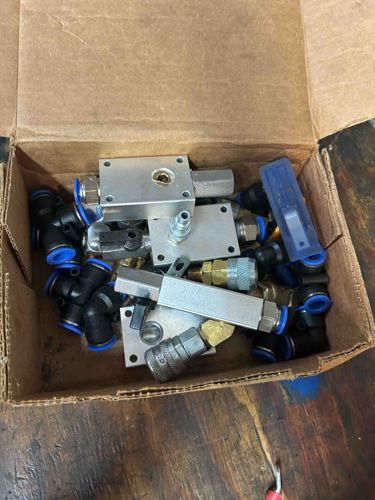
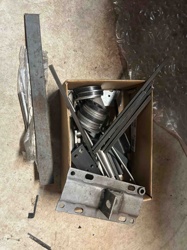
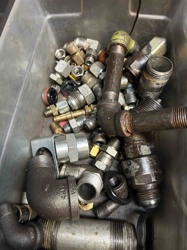
This box contains a miscellaneous assortment of pneumatic fittings and components, appearing to be primarily for air systems. The items include several rectangular silver-colored metal blocks that are likely manifold blocks or distribution units, each featuring multiple threaded ports for connecting hoses or other components. These blocks show a clean, machined finish, suggesting they are made of aluminum or a similar light, non-corrosive metal. They have a satin appearance, indicative of a brushed or anodized finish, and some exhibit visible screw holes for mounting.
Also present are numerous black plastic elbow fittings, distinguished by bright blue plastic rings at their connection points. These are push-to-connect fittings, designed for quick and easy hose insertion and removal. Their condition appears good, with no obvious cracks or severe wear on the plastic components. Furthermore, there are several brass-colored fittings, including what looks like quick-disconnect couplers and possibly some threaded adapters. These brass components show some minor discoloration or patina, consistent with age or light use, but no significant damage like deformation or heavy corrosion is readily apparent.
One blue plastic tool or component with a clear cover is also visible, though its exact function isn't entirely clear. The overall collection suggests a range of components used in pneumatic systems, likely for manufacturing, automation, or workshop applications. The mix of materials (aluminum/metal, plastic, brass) indicates various functions and pressure ratings. There are no clear manufacturer's marks visible in the provided image, but the quality of machining on the metal blocks and the consistent design of the plastic fittings suggest commercially produced items. The items appear to be in used but functional condition, with typical signs of handling and storage in a work environment.
AI Appraisal Report
I have examined the provided image of the Assorted Pneumatic Air Line Fittings and Manifold Blocks. The collection consists of several aluminum manifold blocks, numerous black plastic push-to-connect elbow fittings with blue rings, and various brass fittings including quick-disconnect couplers. Condition appears used but functional, with typical signs of handling like minor discoloration on brass and light wear on plastic, though no significant damage is apparent.
The aluminum manifold blocks show good machining, indicating commercial production quality. The plastic fittings are consistent in design, suggesting a reputable manufacturer, though no specific marks are visible. The brass components also appear to be standard industrial fittings. The general absence of severe corrosion or major defects suggests these components are still serviceable.
Market conditions for used pneumatic fittings are generally stable, driven by industrial and workshop needs for automation and repairs. While individual used fittings have low value, the assortment and inclusion of multiple manifold blocks enhance the overall utility. Comparables would include bulk lots of surplus industrial fittings or unbranded sets from online marketplaces.
Demand for such components is consistent, but rarity is low given they are standard industrial items. The value is primarily driven by their collective utility rather than scarcity or collectible appeal. The blue plastic tool's function is unclear, limiting its appraisal contribution.
Factors significantly impacting value include the number and size of the manifold blocks, the quantity and types of plastic fittings (elbows are common), and the condition and specific types of brass fittings (e.g., specialized couplers). The fact that they are an assorted lot, without guaranteed integrity for critical applications, slightly reduces per-unit value.
Limitations in authenticity verification from images alone are significant. I cannot definitively confirm brand origin, precise material composition (e.g., aluminum grade), or internal condition of the fittings (e.g., seals, valve integrity in couplers). An in-person examination would allow for tactile assessment of material quality, checking for internal wear, verifying thread integrity, and identifying any subtle manufacturer markings. Pressure testing would be needed to confirm sealing capabilities and functional integrity. Without these, the appraisal reflects a “parts lot” valuation rather than certified, ready-for-service components from a guaranteed source.