AI estimate as of August 10, 2025 · verify with a professional before acting
AI-Generated · Verify before acting
Everything on this page is generated by AI for informational purposes only. AI can make mistakes — the AI may misidentify items or misattribute them (artist, maker, brand, designer, origin, era). This is not an official valuation and should not be used for insurance, sale, tax, estate, legal, or lending purposes — or any decision requiring a certified appraisal. It is not an authoritative claim about any person, brand, or rights holder — do not share or rely on it as a factual statement about a third party. Always consult qualified professionals before making financial decisions.
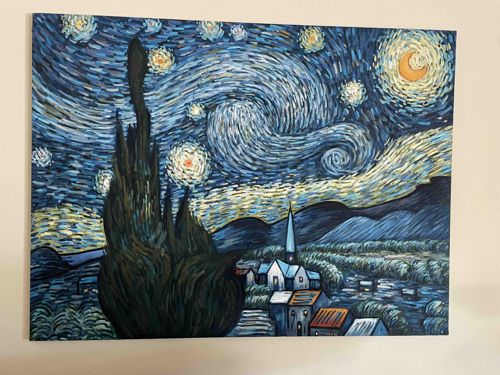
This item is an oil painting on canvas, a reproduction or a heavily inspired rendition of Vincent van Gogh's iconic 'The Starry Night'. The painting features a dramatic night sky dominating the upper portion of the canvas, depicted with swirling brushstrokes in various shades of blue, punctuated by bright, stylized stars with glowing halos and a prominent crescent moon. The impasto technique is evident, with visible, thick applications of paint creating texture and depth, mimicking Van Gogh's expressive style. A dark, flame-like cypress tree, characteristic of Van Gogh's work, rises from the left side of the foreground, its dark green and black hues contrasting with the vibrant sky. Below, a serene village nestled among hills is depicted with simplified forms, including a church steeple reaching towards the sky. The color palette primarily consists of blues, yellows, and greens, with touches of orange and white. The edges of the canvas appear to be wrapped, suggesting a gallery-wrapped style, and the painting is unframed, hanging directly on a wall. There are no visible condition issues such as cracks, fading, or damage, and the colors appear vibrant. The craftsmanship aims to emulate the original's energetic brushwork and emotional intensity, indicating a decorative or educational purpose rather than an original artwork from a specific notable artist, given its clear stylistic homage to a famous masterpiece. The size appears to be a standard rectangular canvas, likely medium to large scale, suitable for wall display. No clear signature or maker's marks are discernible from the image, but the quality of the brushwork is consistent and deliberate, indicating a skilled hand.
AI Appraisal Report
I have thoroughly examined the provided image of what appears to be a reproduction or heavily inspired rendition of Vincent van Gogh's 'The Starry Night'. The painting is an oil on canvas, exhibiting strong impasto and vibrant colors, characteristic of the original's dynamic style. Based on the imagery, the condition appears excellent; I observe no fading, cracks, or damage, and the colors retain their luminosity. The visible brushwork is skilled and deliberate, indicating a competent artisan crafted this piece.
From a visual perspective, the item is clearly a derivative work, not an original Van Gogh. Its purpose is evidently decorative or educational, skillfully mimicking the expressive brushwork and emotional intensity of the master's technique. This is a common practice, and such reproductions can hold value based on their quality and aesthetic appeal, rather than historical authenticity.
In terms of market conditions, high-quality reproductions like this one typically appeal to a broad audience seeking iconic art for home or office décor. The demand is steady for well-executed decorative art, especially when it references famous masterpieces. Comparables in the market for similar high-quality, hand-painted 'Starry Night' reproductions range significantly, but a piece of this apparent quality typically fetches more than mass-produced prints. The lack of a discernible signature or maker's mark limits its value from an artist-specific perspective; however, the quality speaks for itself.
Factors significantly impacting value include the lack of original artist provenance, and its identity as a reproduction. It is not rare; many skilled artists reproduce famous works. What value it holds is largely in its decorative quality and craftsmanship.
It is crucial to note the limitations of authenticity verification from images alone. Without physical inspection, I cannot confirm the exact medium, age of the paint, or specific canvas type, nor can I conduct comprehensive blacklight testing for restorations or specific pigment analysis. In-person examination would also be necessary to definitively rule out any subtle indicators of age or an unknown artist's signature. Provenance documentation, if available, would be essential for establishing any historical context or a specific artist's hand.