AI estimate as of July 29, 2025 · verify with a professional before acting
AI-Generated · Verify before acting
Everything on this page is generated by AI for informational purposes only. AI can make mistakes — the AI may misidentify items or misattribute them (artist, maker, brand, designer, origin, era). This is not an official valuation and should not be used for insurance, sale, tax, estate, legal, or lending purposes — or any decision requiring a certified appraisal. It is not an authoritative claim about any person, brand, or rights holder — do not share or rely on it as a factual statement about a third party. Always consult qualified professionals before making financial decisions.
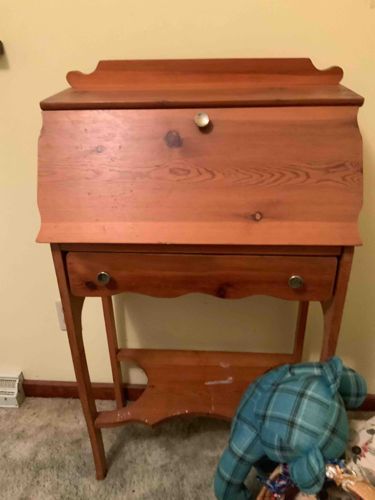
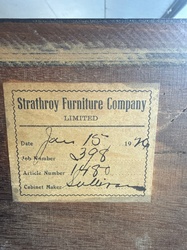
The item is a wooden secretary desk or writing desk, constructed primarily of what appears to be pine or a similar light-colored softwood, showcasing a visible grain pattern with several prominent knots. The wood is finished with a reddish-brown stain or lacquer, giving it a warm, somewhat rustic appearance. Physically, it features an upper hutch with a sloped, hinged lid that likely opens to reveal a writing surface and storage compartments. This lid is secured by a single, round, light-colored knob, possibly ceramic or glass, positioned centrally. The top of the hutch includes a decorative backboard with a gentle S-curve on each side, adding a period touch. Below the hutch, there is a single drawer, distinguished by a scalloped decorative apron directly beneath it. This drawer is equipped with two small, round metal pulls, possibly brass or pewter, which show some tarnish or wear. The desk stands on four slender, gently curved legs, tapering slightly towards the bottom. A single horizontal shelf connects the front and back legs at a lower level, providing an additional storage or display surface and contributing to the stability of the piece. The overall construction appears utilitarian but solid. Visible condition issues include a notable dark stain or discoloration on the upper hutch lid to the left of the knob, and some white paint splatters or marks on the lower shelf and the base of the legs, indicating past use or proximity to crafting activities. The finish itself appears somewhat worn in areas, suggesting a modest patina consistent with age and use. There are no readily discernible manufacturer marks or signatures from the provided image. Based on the style, particularly the scalloped drawer apron, curved legs, and simple construction, it likely dates from the late 20th century, possibly a reproduction piece or from a furniture line that emphasized a country or primitive aesthetic. The craftsmanship appears to be factory-made rather than bespoke, with consistent lines and finishes.
AI Appraisal Report
Upon examining the provided image of this pine secretary desk, I note its rustic charm and utilitarian design. The visible grain and knots, along with the reddish-brown finish, align with a country or primitive aesthetic. Condition-wise, I observe a notable dark stain on the hutch lid and white paint splatters on the lower shelf and legs, suggesting practical use and some wear consistent with age. These cosmetic issues slightly detract from its visual appeal. Authenticity-wise, based on the style cues such as the scalloped drawer apron, curved legs, and seemingly factory-made construction, this piece appears to be a late 20th-century reproduction, rather than an antique. It’s likely a mass-produced item designed to evoke an older feel. In current market conditions, there is a moderate but not exceptional demand for such 'country style' furniture. Comparable pieces, often found in vintage or secondhand markets, typically fall within a similar price range depending on condition and specific design elements. Its practicality as a writing desk and storage unit adds to its marketability. However, it is neither rare nor exceptionally unique, which limits its ceiling value. Factors significantly impacting value include the visible cosmetic damage, its likely reproduction status, and mass-market appeal rather than bespoke craftsmanship. To fully verify authenticity and precise dating, a physical examination would be crucial to assess joinery, wood aging, and internal construction methods. Additionally, any provenance documentation would be invaluable. Without these, my assessment of its age and origin remains an informed estimation based solely on visual cues.