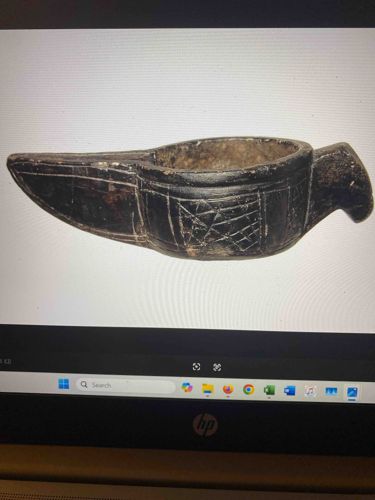
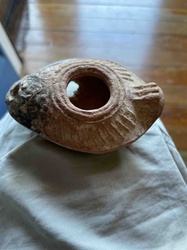
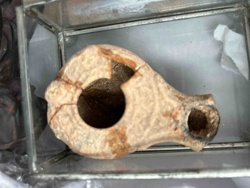
Gandharan chlorite lamp, Bactria, 2nd millennium BC. Nicely carved with vertical walls, tapered channel spout. Incised geometric decorations. 5 1/2” length. Ex collection of Eugene Behlen, Florida, formerly of the Smithsonian Institution.
These notes were written by the person who submitted this item. Appraiser.AI has not verified them, and the AI's identification and estimate may rely on them.
AI Estimated Value
Not an official valuation
$8,000 - $12,000
AI estimate as of July 18, 2025 · verify with a professional before acting
AI-Generated · Verify before acting
Everything on this page is generated by AI for informational purposes only. AI can make mistakes — the AI may misidentify items or misattribute them (artist, maker, brand, designer, origin, era). This is not an official valuation and should not be used for insurance, sale, tax, estate, legal, or lending purposes — or any decision requiring a certified appraisal. It is not an authoritative claim about any person, brand, or rights holder — do not share or rely on it as a factual statement about a third party. Always consult qualified professionals before making financial decisions.
This analysis also relies on unverified notes provided by the user, which may be incomplete or inaccurate and could affect the result.
This is an ancient Gandharan chlorite lamp, originating from Bactria and dated to the 2nd millennium BC. The lamp is carved from chlorite, a dark greenish-black stone, giving it a somewhat mottled, earthy appearance. It measures 5 1/2 inches in length. Its form is elongated, with a broad, deep circular basin for the fuel at one end, transitioning into a tapered channel spout at the other, designed to hold a wick. The walls of the basin and spout are robust and have a rustic, hand-carved quality, suggesting solid construction typical of ancient craftsmanship. The exterior sides of the lamp feature incised geometric decorations, primarily consisting of cross-hatching and grid patterns, which add a level of aesthetic detail and suggest a deliberate artistic effort. Despite its age, the lamp appears to be in relatively good condition, exhibiting a visible patina consistent with centuries of use and burial, which enhances its historical character. There are no obvious signs of major damage or repair, though surface wear and minor chips might be present given its antiquity. The carving, while not highly refined in a modern sense, demonstrates a skilled hand capable of shaping the hard chlorite stone and creating functional and decorative elements. The handle, extending from the back of the basin, is simple and practical. This piece is significant due to its age, material, and geographic origin, providing insight into ancient lighting technology and artistry.
AI Appraisal Report
Upon my virtual examination of this Gandharan chlorite oil lamp, I find its presented condition to be remarkably good for an artifact of its stated age (2nd millennium BC). The visible patina, consistent with centuries of use and burial, strongly supports its antiquity. The incised geometric decorations are well-preserved, suggesting minimal erosion, and the lack of obvious major damage or repairs speaks to its careful handling or fortunate preservation. Authenticity, based solely on the provided image and description, appears highly probable. The style, material (chlorite), and claimed origin (Gandhara/Bactria) align with known ancient lighting devices from that period and region. The 'rustic, hand-carved quality' and 'robust' construction are characteristic of functional utilitarian objects of great age. However, a definitive authentication would necessitate a physical inspection to verify the material's properties (e.g., specific gravity, mineralogical analysis), confirm the tool marks for consistency with ancient techniques, and check for any less obvious repairs or modern interventions. Thermoluminescence dating or carbon dating (if organic residues are present) would provide scientific verification of its age. The provenance, 'Ex collection of Eugene Behlen, Florida, formerly of the Smithsonian Institution,' is excellent and significantly enhances its value, though I would request to view the actual acquisition records for full verification. The market for ancient artifacts, particularly well-provenanced examples, remains robust, driven by collectors and institutions. Pieces from Gandhara of this age are relatively rare, and the chlorite material adds to its unique appeal. The size (5 1/2 inches) is also a desirable characteristic. Comparable items of this quality and age with strong provenance typically command significant prices due to their historical and artistic significance. The absence of specific comparative auction results for an identical piece limits a precise valuation, but general market trends for such antiquities are strong. Demand for genuine, well-preserved ancient lighting devices is consistent.