These notes were written by the person who submitted this item. Appraiser.AI has not verified them, and the AI's identification and estimate may rely on them.
AI Estimated Value
Not an official valuation
$60 - $120
AI estimate as of September 1, 2025 · verify with a professional before acting
AI-Generated · Verify before acting
Everything on this page is generated by AI for informational purposes only. AI can make mistakes — the AI may misidentify items or misattribute them (artist, maker, brand, designer, origin, era). This is not an official valuation and should not be used for insurance, sale, tax, estate, legal, or lending purposes — or any decision requiring a certified appraisal. It is not an authoritative claim about any person, brand, or rights holder — do not share or rely on it as a factual statement about a third party. Always consult qualified professionals before making financial decisions.
This analysis also relies on unverified notes provided by the user, which may be incomplete or inaccurate and could affect the result.
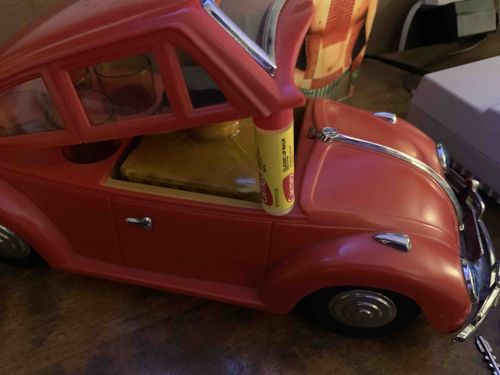
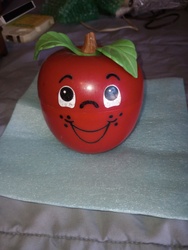
This item is a novelty container shaped like a vintage Volkswagen Beetle, predominantly red in color. Its design mimics the iconic rounded silhouette of the classic VW Bug, featuring distinct fenders, small chrome-colored hubcaps, a chrome-colored strip running down the center of the hood, and chrome-colored door handles. The top portion of the car's body, specifically the roof and window section, appears to lift or open, revealing an interior compartment. Through the clear 'windows' which are likely plastic, one can discern what appear to be small glass tumblers, suggesting its use as a holder for drinks or perhaps a mini bar set. The interior also has a distinct yellow or gold-colored liner or insert. There are visible signs that parts of the car lift open, possibly for access to the contents or to activate a mechanism. Based on the provided context of 'Vw whiskey holder and music box', it's highly probable that this item functions as both. The overall condition shows some minor surface wear consistent with age and handling, such as dust or light scratching, but no significant damage or repairs are immediately apparent. The craftsmanship appears to be commercial grade, designed for novelty or thematic purposes rather than fine antique quality. There are no visible maker's marks or signatures in the provided images, so dating it precisely is difficult, but its style suggests a mid to late 20th-century novelty item. A prominent yellow cylinder, possibly a lip balm tube, is sitting on the hood, which is not part of the item itself but provides a sense of scale. The item serves both a functional and decorative purpose, appealing to collectors of automotive memorabilia, novelty barware, or music boxes.
AI Appraisal Report
Upon examining this novelty Volkswagen Beetle Whiskey Holder and Music Box, I find its condition to be good, consistent with a display or light-use item from the mid to late 20th century. The red finish, chrome-colored accents, and clear plastic 'windows' are largely intact, showing expected minor surface wear like light scratching and dust, but no apparent structural damage, cracks, or significant repairs. The internal yellow lining is visible and appears complete. Authenticity as a novelty item of its type is clear from the visual cues; however, definitive verification of its origin, specific manufacturer, or date of production would require an in-person examination to locate any hidden maker's marks, patent numbers, or material stamps.
From a market perspective, comparable items, often referred to as 'novelty bar sets,' 'musical decanters,' or 'VW collectibles,' typically surface on online marketplaces (e.g., eBay, Etsy) and at antique shops specializing in vintage advertising or kitsch. While VW memorabilia generally holds a broad appeal, and music boxes have a niche market, this specific combination is not exceptionally rare. Demand is moderate, driven primarily by collectors of automotive novelty items or those seeking quirky home decor. The primary value drivers are its charming visual appeal, dual functionality (whiskey holder/music box), and relatively good condition. Factors that would negatively impact value include significant damage, missing components (e.g., glassware, music box mechanism failure), or poor cosmetic condition. While the inclusion of glassware is positive, its quality and completeness can only be fully assessed physically.
Without physical inspection, I cannot confirm the operational status of the music box or the condition/completeness of internal components like the specific tumblers. Therefore, the appraisal range reflects an assumption of functional integrity for both features. Provenance documentation, while unlikely for such a mass-produced novelty item, would add to its historical context but not significantly alter its market value. Scientific testing is not relevant for this type of appraisal.