These notes were written by the person who submitted this item. Appraiser.AI has not verified them, and the AI's identification and estimate may rely on them.
AI Estimated Value
Not an official valuation
$120-200
AI estimate as of October 16, 2025 · verify with a professional before acting
AI-Generated · Verify before acting
Everything on this page is generated by AI for informational purposes only. AI can make mistakes — the AI may misidentify items or misattribute them (artist, maker, brand, designer, origin, era). This is not an official valuation and should not be used for insurance, sale, tax, estate, legal, or lending purposes — or any decision requiring a certified appraisal. It is not an authoritative claim about any person, brand, or rights holder — do not share or rely on it as a factual statement about a third party. Always consult qualified professionals before making financial decisions.
This analysis also relies on unverified notes provided by the user, which may be incomplete or inaccurate and could affect the result.
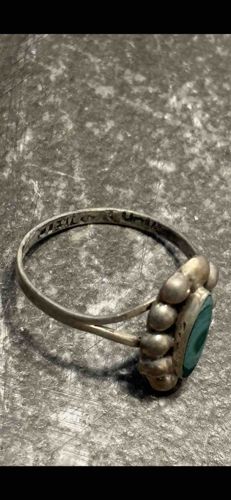
This item is a vintage ring, likely crafted from sterling silver, featuring a vibrant turquoise-colored cabochon stone. The ring's band is a simple, thin silver wire, which appears to split into two near the focal setting, providing a stable base for the central design. The centerpiece is an oval or elongated rounded cabochon, set within a bezel that is surrounded by a distinctive cluster of small, uniform silver beads, adding texture and traditional Southwestern or ethnic charm to the piece. The metal exhibits a noticeable patina, typical of aged silver, suggesting a period of wear and natural oxidation over time. The surface of the metal shows some minor surface scratching and dullness but no significant damage or repairs are immediately visible. On the inside of the band, there are engraved markings, though partially obscured in the image, the word "STERLING" is clearly discernible, confirming the material. Additionally, there appear to be other letters or symbols, possibly a maker's mark or additional hallmarks, that are less clear. The craftsmanship, with its hand-set stone and applied beadwork, suggests a handmade or artisan-crafted piece rather than mass-produced jewelry. The style points to a potential mid-20th century origin, common for Native American or Southwestern style jewelry. The stone itself is a striking blue-green, possibly natural turquoise, though without close-up inspection, it's difficult to ascertain if it's natural, stabilized, or a simulant. The bezel setting securely holds the stone, and the overall construction appears sturdy and well-made despite its age.
AI Appraisal Report
I have examined the provided image of this vintage turquoise cabochon ring. The item appears to be authentic sterling silver, as indicated by the discernible 'STERLING' mark on the interior band, which is crucial for material verification. The presence of a natural patina, minor surface scratches, and dullness is consistent with a genuine vintage piece and its age, indicating regular wear rather than significant damage or repair. The bezel-set, oval turquoise-colored cabochon, surrounded by sterling silver beadwork, is typical of Southwestern or Native American artisan-crafted jewelry, likely dating to the mid-20th century. The split-shank band further supports this aesthetic and construction. Demand for vintage Southwestern jewelry, especially pieces featuring natural stones and handcrafted details, remains consistent within specialized markets and among collectors. Its rarity is moderate; while hand-crafted, similar styles were produced. Factors impacting value positively include the 'STERLING' hallmark and the artisan craftsmanship. Negatively, without in-person inspection, I cannot definitively confirm if the turquoise is natural, stabilized, or a simulant, which significantly impacts value. Lack of a clear maker's mark also affects potential attribution to a specific artisan or tribe, thus limiting its top-tier value potential. For full authentication and a more precise valuation, I would require in-person examination to assess the stone's type (natural vs. treated vs. simulant), a clearer view of any additional hallmarks for maker identification, and ideally, any provenance documentation.