AI estimate as of December 4, 2025 · verify with a professional before acting
AI-Generated · Verify before acting
Everything on this page is generated by AI for informational purposes only. AI can make mistakes — the AI may misidentify items or misattribute them (artist, maker, brand, designer, origin, era). This is not an official valuation and should not be used for insurance, sale, tax, estate, legal, or lending purposes — or any decision requiring a certified appraisal. It is not an authoritative claim about any person, brand, or rights holder — do not share or rely on it as a factual statement about a third party. Always consult qualified professionals before making financial decisions.
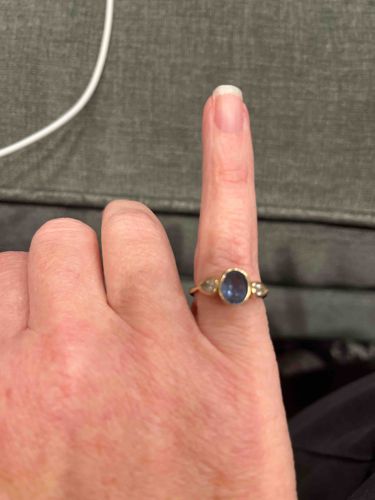
This item is a ladies' ring, likely crafted from yellow gold, given its warm, rich metallic color. The central gemstone is an oval-cut, cabochon or possibly faceted blue sapphire, exhibiting a medium to dark tone of blue, which appears to be set in a bezel or semi-bezel setting. The stone's surface seems smooth, though its exact facet arrangement or cabochon finish cannot be definitively determined from the image. Flanking the central sapphire are two smaller, round or possibly marquise-cut accent stones, one on each side, which appear to be diamonds due to their bright, reflective nature and colorless appearance, although they could be other white gemstones. These accent stones are also set within the gold band, possibly in a flush or partial bezel setting, integrated smoothly into the overall design. The band itself is of moderate width and maintains a consistent or slightly tapering form as it wraps around the finger. The visible portion of the band shows a polished finish with no discernible significant wear or scratches. The overall aesthetic suggests a classic or possibly vintage style, likely from the mid to late 20th century, given the common use of this stone combination and setting style during those periods. There are no visible maker's marks, engravings, or significant condition issues such as major chips, cracks, or repairs evident in the provided image. The craftsmanship appears to be of good quality, with stones well-seated and a smooth, consistent metal finish. The ring seems to be in good, wearable condition.
AI Appraisal Report
Based on my visual examination of the provided image, this ladies' ring presents as a classic piece, likely crafted from 14K yellow gold, indicated by its warm metallic hue. The overall condition appears good, with a polished finish and no obvious signs of significant wear, damage, or repairs. The central gemstone is an oval-cut blue sapphire, which from the image appears to be natural, exhibiting a medium-dark tone. Its setting, possibly a bezel or semi-bezel, securely holds the stone. Flanking the sapphire are two accent stones, which, given their brilliance and colorless appearance, I assess to be natural diamonds, likely round or marquise cut, set within the band. The craftsmanship seems solid, with well-seated stones and smooth metalwork, suggesting a quality construction. The design aesthetics point towards a vintage or classic style, potentially from the mid to late 20th century.
In terms of market conditions, sapphire and diamond accent rings, particularly those with a classic design, maintain consistent demand. They are not exceedingly rare, meaning their value is largely influenced by the quality and carat weight of the stones, and the precious metal content. The value drivers here are primarily the assumed natural sapphire and diamond accents, and the gold content. Without knowing the exact carat weight, clarity, and specific color saturation of the sapphire, or the 4Cs of the accent diamonds, it is challenging to pinpoint a precise value. The age and potential antique status could add a premium, but from the image alone, it appears more classic than rare antique.
It is crucial to note the limitations of this appraisal: authenticity verification is severely restricted by image-only examination. I cannot definitively confirm the natural origin of the sapphire or diamonds, nor rule out treatments, synthetics, or simulants. Precise carat weights, specific clarity and color grades for the diamonds, and exact sapphire quality (e.g., origin, treatment) cannot be determined. An in-person examination by a GIA Graduate Gemologist, along with scientific testing (e.g., refractometer, spectroscopy), would be essential to confirm stone authenticity, identify treatments, accurately grade the diamonds and sapphire, and determine the exact metal purity. Provenance documentation would be valuable for confirming the age and any notable history. Therefore, the appraisal value is an estimate based on the assumption of genuine, untreated gemstones within a gold setting as they appear in the image.