AI estimate as of September 27, 2025 · verify with a professional before acting
AI-Generated · Verify before acting
Everything on this page is generated by AI for informational purposes only. AI can make mistakes — the AI may misidentify items or misattribute them (artist, maker, brand, designer, origin, era). This is not an official valuation and should not be used for insurance, sale, tax, estate, legal, or lending purposes — or any decision requiring a certified appraisal. It is not an authoritative claim about any person, brand, or rights holder — do not share or rely on it as a factual statement about a third party. Always consult qualified professionals before making financial decisions.
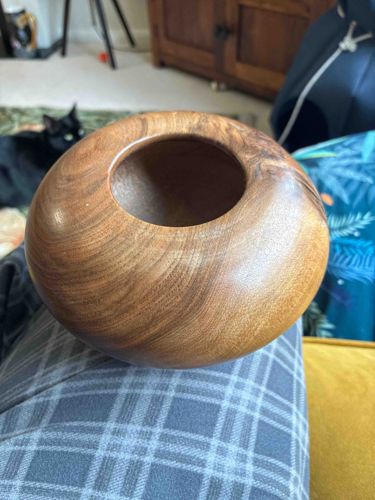
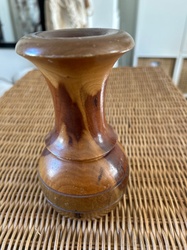
This item is a decorative vessel, likely a bowl or short vase, expertly crafted from a single piece of hardwood, exhibiting a rich, warm brown coloration with occasional darker undertones and a noticeable grain pattern that adds visual depth. The object features a smoothly turned, globular or orb-like exterior body, giving it a substantial and organic feel. Its circular opening at the top is relatively wide in proportion to the overall size, showcasing the interior's consistent finish with the exterior. The surface appears to be finely sanded and polished to a satin or semi-gloss finish, reflecting ambient light gently. There are no immediate visible signs of major damage such as cracks, chips, or significant scratches, suggesting good preservation or careful handling. The wood grain swirls around the object's form, emphasizing its handcrafted nature. The craftsmanship appears to be of high quality, with smooth transitions and a uniform finish indicating skilled woodworking. Due to its traditional form and material, it could be contemporary or vintage, likely dating from the mid to late 20th century to the present day. Without maker's marks or a discernible base in the image, further identification of specific origin or age is limited, but its polished appearance and smooth contour suggest it was intended for aesthetic display rather than functional use as a common utilitarian bowl.
AI Appraisal Report
Based on my visual examination of the provided image, this turned wood decorative bowl/vase appears to be in excellent condition. The surface presents a finely sanded and polished satin or semi-gloss finish, reflecting ambient light gently. There are no visible signs of major damage such as cracks, chips, or significant scratches, indicating good preservation. Authenticity, based solely on visual inspection, suggests it is indeed a handcrafted turned wood item. The rich, warm brown coloration and prominent grain pattern enhance its aesthetic appeal.
In terms of market conditions, turned wood decorative objects of this quality, without specific artist attribution or historical significance, fall into a broad decorative arts category. Comparables on the secondary market (e.g., online marketplaces, craft fairs, antique shops) typically range depending on size, wood type, and craftsmanship. This piece exhibits high-quality craftsmanship with smooth transitions and a uniform finish. Demand for such items is steady among those appreciating artisan craft and natural materials, but rarely reaches high-end collector prices without provenance.
Factors significantly impacting its value include the skilled craftsmanship evident and the good condition. However, the lack of maker's marks or discernible artist signature limits its potential for higher valuation. While visually appealing, it is not particularly rare in the broader market of turned wood art.
It is crucial to note the limitations of authenticating solely from images. A physical, in-person examination would be necessary to identify the specific type of hardwood, assess internal integrity, and meticulously check for any subtle repairs or wear not visible in photographs. Furthermore, provenance documentation, such as artist information or sales records, would be essential for definitive authentication of origin, age, and artist attribution, which could significantly impact its value. Without such documentation or physical inspection, a precise artist or specific age range beyond 'mid to late 20th century to present day' cannot be definitively determined, thus influencing the conservative appraisal range.