AI Appraisal Estimate

AI-generated estimates · not official valuations

From the user

What was submitted

Photo and notes provided by the user — not generated by AI

Submitted item photo
Submitted photo · June 1, 2026

User's notes

No additional notes provided.

AI analysis below

AI appraisal

AI analysis & estimate

AI-Generated · Verify before acting

Everything below is generated by AI for informational purposes only. AI can make mistakes — the AI may misidentify items or misattribute them (artist, maker, brand, designer, origin, era). This is not an official valuation and should not be used for insurance, sale, tax, estate, legal, or lending purposes — or any decision requiring a certified appraisal. It is not an authoritative claim about any person, brand, or rights holder — do not share or rely on it as a factual statement about a third party. Always consult qualified professionals before making financial decisions.

Read the full disclaimer

AI Identification

·Not independently authenticated·Verify before acting

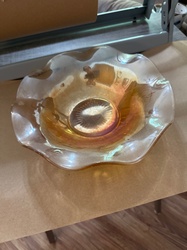
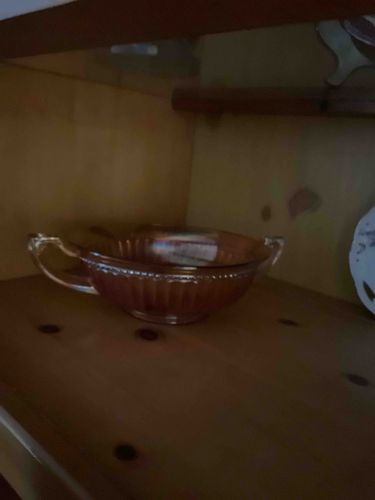
Marigold Carnival Glass Double-Handled Bonbon Dish

Antique Glassware / Collectible Glass

AI Estimated Value

·Not an official valuation·Verify before acting

$45.00-$65.00

As of June 1, 2026

AI Item Analysis

·AI can make mistakes·Verify before acting
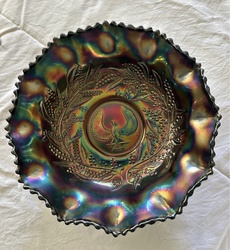
This is a vintage marigold-colored carnival glass bonbon dish, likely dating from the early to mid-20th century. The piece features a distinct iridescent or 'aurora borealis' finish over a rich amber/orange base glass, characteristic of the marigold pressing technique popularized by makers like Fenton, Indiana Glass, or Northwood. The dish is oval or round in shape with a shallow bowl and features two ornate, scrolled handles on opposite sides. The exterior body exhibits a vertical ribbed or fluted pattern, topped by a textured decorative border near the rim. The iridescent coating shows a range of metallic hues, including gold, pink, and copper, which shift under the light. The craftsmanship reflects the production methods of the Depression era, where pressed glass was treated with metallic salts to achieve a lustrous appearance. In terms of condition, the glass appears free of major chips or cracks, though typical age-related wear such as minor surface scratches or 'flea bites' on the base and handles may be present. The iridescence seems reasonably well-preserved, though there may be slight thinning of the finish on higher-relief areas due to handling and cleaning over time. The overall construction is solid, representing a classic example of affordable American art glass from the Art Deco or late Victorian influence periods.
AI Appraisal Report

·AI can make mistakes·Verify before acting
This marigold carnival glass bonbon dish displays the characteristic 'oil slick' iridescence achieved through the application of metallic salts during the cooling process, consistent with early 20th-century production. Based on the vertical ribbing and scrolled handle design, this piece is likely a product of the Fenton Art Glass Company or Indiana Glass. The iridescence remains vibrant, showing a strong spectrum of copper and pink hues, though minor 'rubbing' is visible on the high-relief areas of the handles, which is standard for pieces of this age. Market demand for marigold carnival glass is currently stable but specialized; while once highly sought after, younger collectors gravitate toward rarer colors like amethyst or peacock blue. Common shapes such as bonbon dishes and candy bowls are plentiful in the secondary market, keeping the valuation within a modest range. Factors negatively impacting value include the ubiquity of this specific pattern and the presence of minor 'flea bites' on the base. Positive value factors include the clarity of the pressing and the lack of 'cloudiness' in the finish. Authenticity appears consistent with late Depression-era pressing techniques; however, a definitive attribution requires a tactile inspection for maker's marks, which are often faint or absent. I cannot definitively rule out later mid-century reproductions without examining the glass weight and mold seam sharpness in person. A full authentication would require verifying the 'snap' of the glass and checking for specific tool marks characteristic of period manufacturers.

Get your items appraised

Instant estimates of your treasures with AI-powered appraisals

Browse More Appraisals