From the user

What was submitted

Photo and notes provided by the user — not generated by AI

Submitted item photo
Submitted photo · May 16, 2026

User's notes

2 cent stamp

AI analysis below

AI appraisal

AI analysis & estimate

AI-Generated · Verify before acting

Everything below is generated by AI for informational purposes only. AI can make mistakes — the AI may misidentify items or misattribute them (artist, maker, brand, designer, origin, era). This is not an official valuation and should not be used for insurance, sale, tax, estate, legal, or lending purposes — or any decision requiring a certified appraisal. It is not an authoritative claim about any person, brand, or rights holder — do not share or rely on it as a factual statement about a third party. Always consult qualified professionals before making financial decisions.

Note

This analysis also relies on unverified notes provided by the user, which may be incomplete or inaccurate and could affect the result.

Read the full disclaimer

AI Identification

·Not independently authenticated·Verify before acting

United States 2-Cent George Washington Carmine Postage Stamp (Washington-Franklin Series)

Philately / Postage Stamps

AI Estimated Value

·Not an official valuation·Verify before acting

$0.05 - $0.25

As of May 16, 2026

AI Item Analysis

·AI can make mistakes·Verify before acting
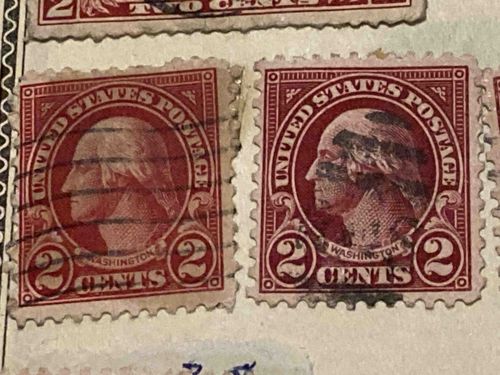
Shown are two examples of the United States 2-cent red postage stamp featuring the profile of George Washington. These stamps are part of the long-running Washington-Franklin Series, typically dated between 1908 and 1922. The design consists of a central medallion with Washington's profile facing left, encircled by 'UNITED STATES POSTAGE' and flanked by the numeral '2' in bottom corners within decorative scrollwork. The color is a deep carmine or rose-red on off-white paper. Physically, the left stamp shows horizontal wavy-line machine cancellations, while the right stamp features a heavier, darker smudge-style postmark over Washington’s face. Regarding condition, the stamps exhibit typical characteristics of circulated philatelic material: the perforations on the left stamp are irregular and slightly worn at the top and bottom edges, and the centering is moderately off to the left. The paper shows slight toning consistent with age. Both stamps appear to have been previously hinged or mounted. These stamps were produced by the Bureau of Engraving and Printing using the flat plate or rotary press process; specific identification would require measuring perforations and checking for watermarks to determine the exact Scott catalog number (e.g., #406, #407, #499, or #527), which significantly affects rarity.

AI Appraisal Report

·AI can make mistakes·Verify before acting
I have conducted a visual examination of the two United States 2-Cent George Washington Carmine stamps from the Washington-Franklin Series. Both specimens exhibit signs of heavy postal circulation, including machine wavy-line cancellations and dark postmark smudging. The centering on both stamps is poor, significantly shifted to the left and bottom respectively, which negatively impacts the grade. The perforations show typical wear and irregularities consistent with standard consumer use of the period. The Washington-Franklin Series is one of the most complex in U.S. philately due to numerous variations in perforation, watermarks, and printing methods (flat plate vs. rotary press). However, without specialized tools—specifically a precision perforation gauge and watermark fluid—it is impossible to distinguish between the common Scott #499 (of which billions were printed) and rare varieties like the Scott #544. Based on the provided imagery and the high volume of common varieties surviving in this condition, these examples appear to be the most common versions. The market for common, used, and poorly centered Washington-Franklin stamps is saturated, typically yielding only nominal value. For a definitive identification, I would require a physical examination to verify the watermark (if any) and an exacta perforation count to rule out rare sub-types. Authenticity of the design is likely, as these are low-value denominations not frequently forged, but their condition limits interest to casual collectors rather than high-end investors. Provenance documentation is not required for items of this nominal value, but professional grading by the PSE or PF would be necessary if a rare variety were suspected.

Get your items appraised

Instant estimates of your treasures with AI-powered appraisals

Browse More Appraisals