These notes were written by the person who submitted this item. Appraiser.AI has not verified them, and the AI's identification and estimate may rely on them.
AI Estimated Value
Not an official valuation
$75-125
AI estimate as of August 18, 2025 · verify with a professional before acting
AI-Generated · Verify before acting
Everything on this page is generated by AI for informational purposes only. AI can make mistakes — the AI may misidentify items or misattribute them (artist, maker, brand, designer, origin, era). This is not an official valuation and should not be used for insurance, sale, tax, estate, legal, or lending purposes — or any decision requiring a certified appraisal. It is not an authoritative claim about any person, brand, or rights holder — do not share or rely on it as a factual statement about a third party. Always consult qualified professionals before making financial decisions.
This analysis also relies on unverified notes provided by the user, which may be incomplete or inaccurate and could affect the result.
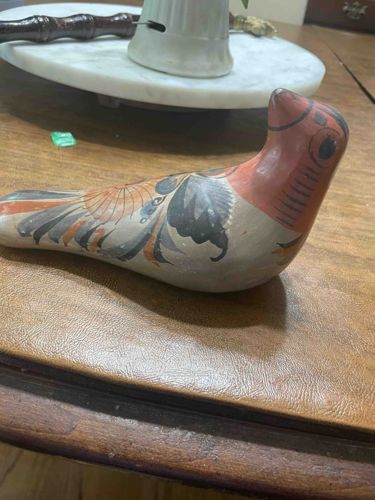
This is a hand-painted pottery bird believed to be of Mexican origin. The bird is horizontally elongated, designed to rest flat on a surface as an ornamental piece. Its primary color palette includes a terracotta-like reddish-orange for the head and chest area, contrasting with a light, unglazed, or perhaps off-white / light tan bisque-like body. The wings and tail are adorned with intricate dark grey/black and orange patterned designs. The patterns suggest stylized feathers, possibly featuring floral or abstract motifs within the feather-like shapes. The eye of the bird is depicted as a simple black circle with a smaller white or light-colored dot, giving it a somewhat simplistic, folk-art appeal. The craftsmanship appears to be hand-molded and hand-painted, indicative of traditional pottery techniques. The surface shows a slightly matte finish, typical of unglazed or lightly glazed earthenware. There are no visible chips, cracks, or significant damage, suggesting it is in good vintage condition. The slight unevenness in coloration and lines further emphasizes its handmade nature. No clear maker's marks or signatures are discernible from the provided image, but the style strongly suggests a mid-20th century to contemporary Mexican folk art aesthetic. The overall quality reflects a charming piece of artisanal work.
AI Appraisal Report
I have examined the provided image and description of this Mexican Hand-Painted Pottery Bird Figurine. Based on my visual assessment, the item appears to be in good vintage condition, exhibiting no visible chips, cracks, or significant damage. The slight irregularities in color and line work are consistent with handmade folk art and do not detract from its appeal. The style, characterized by its terracotta-like reddish-orange, unglazed body, and intricate patterned designs, strongly suggests Mexican origin, likely mid-20th century to contemporary. The craftsmanship reflects traditional pottery techniques.
Market conditions for Mexican folk art, particularly decorative pottery, are generally steady. While demand exists for charming, handcrafted pieces, the absence of a discernible artist's signature or specific pottery mark limits its appeal to dedicated collectors seeking provenance or rare examples. Comparable items in the broader market for Mexican decorative pottery typically range based on size, artist recognition, and complexity of design. Pieces by unknown artisans, even if well-executed, do not command the same prices as those by renowned masters.
The rarity of this specific design is difficult to determine without extensive market research, but similar bird figurines are not uncommon in the folk art sphere. Therefore, this piece is likely more common than rare. The primary factor impacting its value is the lack of verifiable maker's marks or provenance, which significantly restricts its collectibility and market ceiling. Without this, it falls into the category of charming decorative art rather than a highly sought-after collectible.
It is crucial to note that my authenticity verification is limited to visual examination of the image. For full authentication, an in-person physical examination would be necessary to assess the pottery's exact texture, weight, and subtle surface characteristics. Furthermore, scientific testing of the materials or glazes could confirm age. Most importantly, provenance documentation, such as receipts or exhibition history, would be critical to definitively attribute it to a specific maker or region.