AI Appraisal Estimate

AI-generated estimates · not official valuations

From the user

What was submitted

Photo and notes provided by the user — not generated by AI

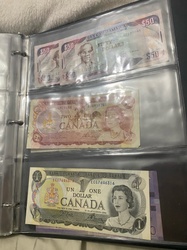
Submitted item photo
Submitted photo · June 3, 2026

User's notes

No additional notes provided.

AI analysis below

AI appraisal

AI analysis & estimate

AI-Generated · Verify before acting

Everything below is generated by AI for informational purposes only. AI can make mistakes — the AI may misidentify items or misattribute them (artist, maker, brand, designer, origin, era). This is not an official valuation and should not be used for insurance, sale, tax, estate, legal, or lending purposes — or any decision requiring a certified appraisal. It is not an authoritative claim about any person, brand, or rights holder — do not share or rely on it as a factual statement about a third party. Always consult qualified professionals before making financial decisions.

Read the full disclaimer

AI Identification

·Not independently authenticated·Verify before acting

United States 10,000 dollar note in the style of the 1863 series

Paper Currency

AI Estimated Value

·Not an official valuation·Verify before acting

$50 - $10,000+

As of June 3, 2026

AI Item Analysis

·AI can make mistakes·Verify before acting
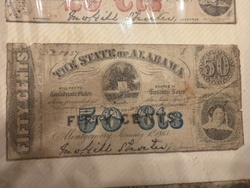
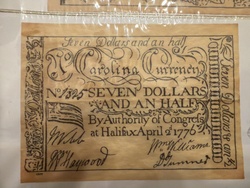
This item appears to be a United States 10,000 dollar note, bearing a design consistent with high-denomination currency from the late 19th century. The note features a portrait within an oval on the right side, which stylistically represents Andrew Jackson. The text printed on the note includes 'UNITED STATES NOTE', 'ACT OF MARCH 3rd 1863', and 'THIS NOTE IS A LEGAL TENDER FOR TEN THOUSAND DOLLARS'. It also bears signatures consistent with the Register of the Treasury and the Treasurer of the United States from that period. The paper shows significant signs of age and distress, including heavy creasing, multiple folds, and a prominent area of surface loss or tearing in the center. There are visible stains, including a rust-colored or orange blemish in the upper right corner and darkened edges consistent with handling or environmental exposure. The reverse of the note is not visible. While the markings are consistent with an 1863 series note, high-denomination paper currency of this rarity is frequently reproduced or found as facsimile, and its status as a period-correct artifact cannot be verified from a photograph. The physical integrity is poor due to the aforementioned abrasions and central structural damage.
AI Appraisal Report

·AI can make mistakes·Verify before acting
I have examined the image provided of what appears to be a United States 10,000 dollar note in the style of the 1863 series. Based on what I can see, the note bears markings consistent with high-denomination currency of that era, including the portrait of Andrew Jackson and the legal tender clauses. However, I cannot determine the veracity of this piece from a photograph alone. High-denomination notes from the 19th century are exceedingly rare and were often issued as specimens or for bank transfers; consequently, they are frequently found as modern facsimiles or instructional reproductions. The paper shows heavy distress, including significant central tearing and surface loss, which would drastically reduce the value of a period-correct artifact. If this were to be a period-correct 1863 legal tender note, even in this poor condition, it could potentially command a value of $10,000 or substantially more due to extreme rarity. However, if this is a modern reproduction or facsimile—which is common for this specific denomination and design—the market value would typically be negligible, often between $5 and $50 as a curiosity or reference piece. General market demand for high-denomination currency is very high among specialized collectors, but buyers require absolute certainty. To provide a more precise valuation, an in-person physical inspection by a professional numismatist is required to evaluate paper composition, ink depth, and fiber structure. Provenance documentation and a formal evaluation by a third-party grading service would also be necessary to move beyond the current hypothesis that this is a period-correct note. My estimate reflects the massive disparity between a potential museum-grade rarity and a common reproduction, as I cannot verify its status here.

Get your items appraised

Instant estimates of your treasures with AI-powered appraisals

Browse More Appraisals