These notes were written by the person who submitted this item. Appraiser.AI has not verified them, and the AI's identification and estimate may rely on them.
AI Estimated Value
Not an official valuation
$60-120
AI estimate as of December 12, 2025 · verify with a professional before acting
AI-Generated · Verify before acting
Everything on this page is generated by AI for informational purposes only. AI can make mistakes — the AI may misidentify items or misattribute them (artist, maker, brand, designer, origin, era). This is not an official valuation and should not be used for insurance, sale, tax, estate, legal, or lending purposes — or any decision requiring a certified appraisal. It is not an authoritative claim about any person, brand, or rights holder — do not share or rely on it as a factual statement about a third party. Always consult qualified professionals before making financial decisions.
This analysis also relies on unverified notes provided by the user, which may be incomplete or inaccurate and could affect the result.
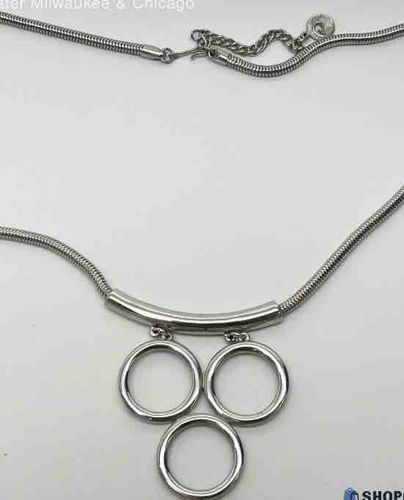
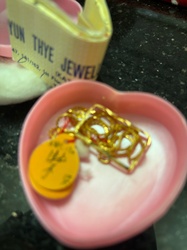
This is a vintage Trifari necklace featuring a sleek snake chain design in a silver-tone metal. The necklace consists of a flexible, tightly woven snake chain that forms the main body of the piece. At the front, the chain passes through a curved, tubular bar, from which three circular ring pendants are suspended. Two rings hang directly below the bar, spaced slightly apart, and a third ring hangs below and centered between the first two, creating a triangular dangle arrangement. The rings appear to be solid, polished metal, consistent with the bright silver-tone finish of the rest of the necklace. The clasp mechanism at the back consists of a simple hook closure connected to a short length of thicker chain, allowing for some adjustability in length. A small, stylized 'T' charm, characteristic of Trifari's branding, is visible near the clasp, indicating its maker. The overall condition appears good, with a consistent metallic luster throughout. Minor surface scratches or areas of slight tarnishing might be present given its age, but no significant damage like bends, breaks, or missing components are evident from the image. The craftsmanship suggests a manufactured piece of costume jewelry, likely dating from the mid to late 20th century, given Trifari's prominence in that era. The design is clean and modernist, utilizing geometric shapes and a smooth, reflective surface, which hints at a mid-century modern aesthetic.
AI Appraisal Report
Upon examining the provided image of the Trifari Snake Chain Pendant Necklace with Rings, I assess its condition to be good. The silver-tone metal exhibits a consistent luster, and the snake chain appears intact and flexible. The three circular ring pendants are present and show no obvious signs of damage such as bends or breaks. The small 'T' charm near the hook clasp reinforces its authenticity as a Trifari piece, a well-regarded manufacturer of costume jewelry. From the visual evidence, minor surface scratches or slight tarnishing, typical for vintage items, might be present but do not significantly detract from its overall appeal.
In terms of market conditions, vintage Trifari costume jewelry enjoys a steady demand among collectors due to its historical reputation for quality and design. This particular piece, with its clean lines and geometric modernist aesthetic, aligns with styles popular from the mid to late 20th century. Comparables for similar Trifari snake chain necklaces with pendants in good condition typically range from $60 to $120 on various online vintage marketplaces and auction sites. While not exceptionally rare, well-maintained Trifari pieces always find an appreciative audience. Factors impacting this value include the reputable Trifari brand, the good visible condition, and the classic, versatile design. The silver-tone finish also tends to perform well in the secondary market.
It is important to note the limitations of authenticity verification solely from an image. While the 'T' charm is a strong indicator, a definitive authentication would ideally require an in-person examination to inspect the quality of the findings, the weight, and the overall construction more closely. Provenance documentation, such as original tags or receipts, would further solidify its history and authenticity. Without a physical inspection, I cannot confirm the absence of subtle structural weaknesses or hidden wear that might affect its long-term durability or value. However, based on the visual information, I am confident in assigning the stated appraisal range.