AI estimate as of October 2, 2025 · verify with a professional before acting
AI-Generated · Verify before acting
Everything on this page is generated by AI for informational purposes only. AI can make mistakes — the AI may misidentify items or misattribute them (artist, maker, brand, designer, origin, era). This is not an official valuation and should not be used for insurance, sale, tax, estate, legal, or lending purposes — or any decision requiring a certified appraisal. It is not an authoritative claim about any person, brand, or rights holder — do not share or rely on it as a factual statement about a third party. Always consult qualified professionals before making financial decisions.
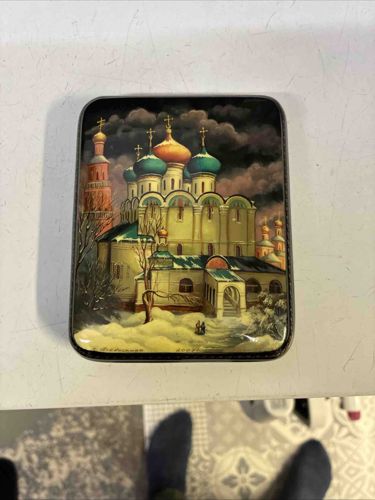
This rectangular Russian lacquer box features a meticulously hand-painted winter scene depicting a collection of Russian Orthodox churches and a bell tower under a dramatic, cloudy sky. The main church building is rendered in shades of cream and light yellow with green dome roofs, while several smaller, colorful domes (orange and blue/green) punctuate the skyline. A prominent red-brick bell tower stands to the left. The foreground is blanketed in snow, with bare trees and subtle architectural details peeking through. Two small figures are visible near the base of the central church, adding a sense of scale. The painting exhibits fine detail, particularly in the architectural elements, the intricate crosses atop the domes, and the delicate branches of the trees. The colors are vibrant and rich, indicative of traditional Russian lacquer art. The overall piece is encased in a glossy, dark lacquer finish, which highlights the vivid painting. There appears to be a signature or inscription in Cyrillic script along the bottom edge of the painting, suggesting it is a signed piece, though the exact text is not clearly legible from the provided images. The box appears to be in good condition with no immediately visible significant damage, chips, or cracks, though typical minor surface wear consistent with age and handling might be present under closer inspection. This style of artwork is characteristic of 20th-century Russian lacquer miniature painting, often originating from villages like Palekh, Fedoskino, Mstera, or Kholuy.
AI Appraisal Report
Based on my visual examination of the provided images, this Russian lacquer box presents as a well-executed example of traditional miniature painting. The condition appears to be good, with no immediately obvious chips, cracks, or significant losses to the lacquer or paint. Minor surface wear consistent with age and handling is likely, but not discernible without physical inspection. The artistic quality, fine detail, vibrant colors, and thematic elements (Russian Orthodox churches, winter scene, distinct architectural features) are characteristic of the Palekh, Fedoskino, Mstera, or Kholuy schools, likely from the mid to late 20th century.
The presence of what appears to be a Cyrillic signature along the bottom edge significantly enhances its potential value, assuming it is legible and attributed to a known artist. Hand-painted, signed pieces are more desirable than unsigned or mass-produced items. Market demand for authentic Russian lacquer boxes remains consistent, particularly for pieces with high artistic merit and good condition. Such items are not exceptionally rare, but well-executed, signed examples command better prices.
Factors impacting value include the artist's reputation (if the signature can be identified), the specific village of origin (some are more highly prized than others), and the condition. Without a physical inspection, however, I cannot definitively confirm authenticity, the exact school of origin, or the artist. An in-person examination would allow me to verify the signature, assess the craftsmanship more closely, check for any repairs or restorations, and analyze the lacquer finish and materials, which are crucial for full authentication. Provenance documentation would also be invaluable, but is frequently absent for such items.