AI Appraisal Estimate

AI-generated estimates · not official valuations

From the user

What was submitted

Photo and notes provided by the user — not generated by AI

Submitted item photo
Submitted photo · June 22, 2026

User's notes

No additional notes provided.

AI analysis below

AI appraisal

AI analysis & estimate

AI-Generated · Verify before acting

Everything below is generated by AI for informational purposes only. AI can make mistakes — the AI may misidentify items or misattribute them (artist, maker, brand, designer, origin, era). This is not an official valuation and should not be used for insurance, sale, tax, estate, legal, or lending purposes — or any decision requiring a certified appraisal. It is not an authoritative claim about any person, brand, or rights holder — do not share or rely on it as a factual statement about a third party. Always consult qualified professionals before making financial decisions.

Read the full disclaimer

AI Identification

·Not independently authenticated·Verify before acting

Neoclassical Bronze Allegorical Figure on Alabaster Base

Fine Art Sculpture

AI Estimated Value

·Not an official valuation·Verify before acting

$4,500 - $6,500

As of June 22, 2026

AI Item Analysis

·AI can make mistakes·Verify before acting
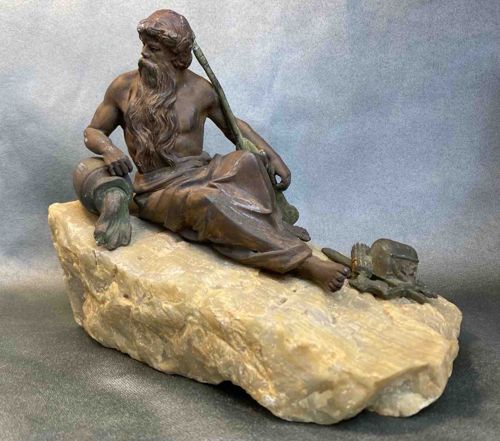
This fine art sculpture depicts a reclining elderly male figure, likely an allegorical representation of a River God or a philosopher, modeled in the Neoclassical style. The figure is cast in bronze with a dark brown and verdigris patina, displaying a muscular torso and a long, flowing beard. He rests upon an amphora or water vessel, from which water appears to be flowing, further reinforcing the aquatic theme. He holds a staff or oar and is draped in classical robes. Beside his feet lies an assembly of objects including what appears to be a helmet and brushes, suggesting a polymathic or multifaceted symbolic representation. The bronze showcases highly detailed casting, seen in the musculature and facial features. The base is a large, rough-hewn block of natural alabaster or light-colored quartz, providing a sharp textural contrast to the smooth bronze. There are visible signs of aging including oxidization and verdigris on the bronze surfaces, particularly around the vessel. The stone base shows minor natural inclusions and some small chips consistent with its age, likely late 19th or early 20th century. No maker’s mark is immediately visible in this view, but the craftsmanship suggests a high-quality Continental European origin.

AI Appraisal Report

·AI can make mistakes·Verify before acting
I have examined the digital representation of the Neoclassical Bronze Allegorical Figure. The craftsmanship is indicative of high-quality late 19th-century Continental sculpture, likely French or Italian. The musculature and treatment of the hair suggest an artist influenced by the Grand Tour aesthetic. The bronze exhibits a complex, multi-layered patina; the verdigris near the amphora appears consistent with natural oxidation over a century, though its placement may have been enhanced to emphasize the 'River God' theme. The integration of a raw alabaster base provides a striking contrast that aligns with late Victorian tastes for combining organic and industrial forms. Technically, the casting is superior, showing little to no loss of detail from the original maquette. The market for 19th-century allegorical bronzes remains stable, with high demand for pieces that balance academic precision with decorative appeal. The lack of a visible signature currently places the value in the mid-range of the market; however, the sheer scale and the use of the substantial stone base elevate its perceived value above standard shelf bronzes. Limitations: This appraisal is based strictly on visual inspection of images. Authenticity and value are subject to physical verification of the foundry mark or artist signature, which may be hidden on the underside of the bronze plinth. I cannot definitively distinguish between a true 19th-century casting and a high-quality mid-20th-century reproduction without examining the interior casting method (sand cast vs. lost wax) and surface cold-work. To finalize authentication, I would require provenance documentation and a macroscopic inspection of the bronze-to-base mounting hardware to ensure contemporary assembly.

Get your items appraised

Instant estimates of your treasures with AI-powered appraisals

Browse More Appraisals