These notes were written by the person who submitted this item. Appraiser.AI has not verified them, and the AI's identification and estimate may rely on them.
AI Estimated Value
Not an official valuation
$150-$250
AI estimate as of September 18, 2025 · verify with a professional before acting
AI-Generated · Verify before acting
Everything on this page is generated by AI for informational purposes only. AI can make mistakes — the AI may misidentify items or misattribute them (artist, maker, brand, designer, origin, era). This is not an official valuation and should not be used for insurance, sale, tax, estate, legal, or lending purposes — or any decision requiring a certified appraisal. It is not an authoritative claim about any person, brand, or rights holder — do not share or rely on it as a factual statement about a third party. Always consult qualified professionals before making financial decisions.
This analysis also relies on unverified notes provided by the user, which may be incomplete or inaccurate and could affect the result.
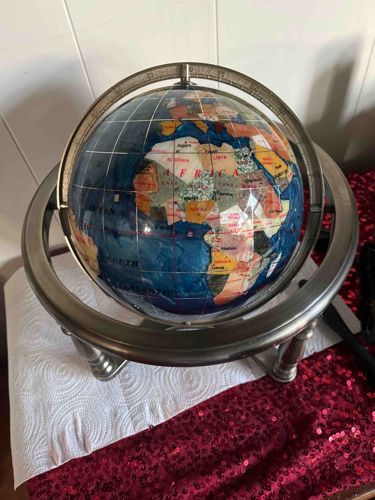
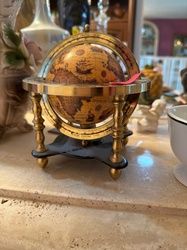
This item is a decorative world globe, featuring a surface intricately inlaid with various natural gemstones and minerals to represent the continents, while the oceans are rendered in a deep lapis-lazuli-like blue material, possibly reconstituted stone or a similar composite. The landmasses display a mosaic of different colored stones, indicating various countries or regions, with country names clearly visible in a contrasting serif font. The globe itself measures approximately 7-9 inches in diameter, based on its appearance within the surrounding stand. It is affixed within a brushed or matte silver-toned metal meridian ring, which appears to have degree markings along its upper edge, suggesting it allows for rotational movement and geographical referencing. This meridian ring is supported by a robust, three-legged metal stand, also with a brushed silver-tone finish. The stand exhibits a classic design with slightly flared, solid legs contributing to its stability. The overall construction suggests a blend of artistic craftsmanship for the globe and utilitarian design for the stand, implying a functional decorative piece rather than a precision cartographic instrument. There are no visible signs of significant damage, wear, or repairs, maintaining a clean and well-preserved appearance. The style is reminiscent of decorative globes popular from the late 20th century onwards, often retailed as executive desk accessories or elegant home decor. The quality of the gemstone inlay, with its polished surface and distinct color variations, indicates a good level of craftsmanship.
AI Appraisal Report
I have examined the provided image and description of this Gemstone Inlaid World Globe with Metal Stand. My assessment of its condition, based solely on the visual information, is excellent; there are no visible signs of damage, wear, or repairs. The gemstone inlay appears well-executed with clear color variations for the landmasses and a consistent lapis-lazuli-like ocean. The metal stand and meridian ring also appear clean and well-preserved.
This item represents a decorative globe, commonly found in the market as executive desk accessories or home decor. The additional detail of a 'spinning 360 globe with compass on base' enhances its decorative and functional appeal, as these features are part of what collectors of such items appreciate. Authenticity, in this context, refers to it being a genuine gemstone globe as described, which from the visual evidence, it appears to be. These globes are largely mass-produced, albeit with handcrafted elements for the stone inlay, and are not considered rare.
Market conditions for such decorative globes are stable. Comparables frequently surface in online marketplaces and antique/home decor shops, with prices varying based on size, quality of stone inlay, and the craftsmanship of the stand. While visually appealing, they do not command high values as collectibles, due to their decorative rather than historical or cartographic significance.
Factors impacting value include the quality and types of gemstones used, the precision of the inlay, the condition of both the globe and the stand, and the presence of additional features like the compass and 360-degree rotation. The globe's approximate 7-9 inch diameter is a common and desirable size for a desk accessory.
Limitations in authenticity verification from images alone exist. To definitively confirm the composition of the gemstones and the 'lapis-lazuli-like' material, an in-person examination would be required. This would allow for tactile inspection and potential use of gemological tools to verify stone types. Without provenance documentation, it's impossible to confirm the origin or specific manufacturing date beyond the general 'late 20th century onwards' style indicated. However, for a decorative item of this nature, such detailed authentication rarely impacts market value significantly unless a claim of rare materials or historical significance were made.