AI estimate as of September 18, 2025 · verify with a professional before acting
AI-Generated · Verify before acting
Everything on this page is generated by AI for informational purposes only. AI can make mistakes — the AI may misidentify items or misattribute them (artist, maker, brand, designer, origin, era). This is not an official valuation and should not be used for insurance, sale, tax, estate, legal, or lending purposes — or any decision requiring a certified appraisal. It is not an authoritative claim about any person, brand, or rights holder — do not share or rely on it as a factual statement about a third party. Always consult qualified professionals before making financial decisions.
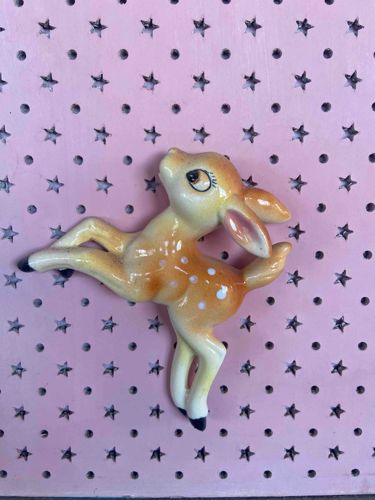
This item is a vintage ceramic figurine depicting a young fawn, likely from the mid-20th century, specifically the 1950s or 1960s, a period known for sweet, kitschy animal motifs in home decor. The fawn is rendered in a whimsical, stylized pose, appearing to prance or leap with its head tilted upwards and legs extended. The primary color is a glossy, warm caramel or light brown glaze on the main body, transitioning to a lighter cream or off-white on the underbelly, lower legs, and the inside of its large, expressive ears. Distinctive white spots are painted across its back and haunches, mimicking the markings of a real fawn. The eyes are particularly notable: large, round, and black with a prominent white highlight or pupil, and delicate black eyelashes painted on the upper lid, giving the fawn a wide-eyed, innocent, and somewhat anthropomorphic expression. The hooves are painted black, providing a sharp contrast to the lighter leg color. The overall construction appears to be solid ceramic or porcelain, with a glossy, possibly crackle-glazed finish visible in certain areas, suggesting age. No obvious chips, cracks, or repairs are visible from the provided image, indicating a relatively well-preserved condition. The quality of craftsmanship is typical for mass-produced decorative ceramics of its era, characterized by hand-painted details and molded forms, appealing for its nostalgic charm. There are no visible maker's marks or signatures in the provided view, but such items were commonly produced by companies in Japan or Taiwan for export to Western markets.
AI Appraisal Report
I have examined the provided image of this vintage ceramic fawn figurine. Based on its appearance, I assess its authenticity as a mid-20th century decorative ceramic to be high, likely dating from the 1950s or 1960s. The whimsical styling, glossy glaze, hand-painted features like the large eyes with lashes, and distinctive white spots are characteristic of mass-produced kitschy animal figurines popular during that era. Its condition appears to be very good, with no obvious chips, cracks, or repairs visible in the image, which significantly contributes to its market desirability. The glossy finish and crackle-glaze hints suggest age-appropriate wear and technique.
Without a maker's mark, attributing it to a specific manufacturer or country of origin (e.g., Japan or Taiwan) is impossible, though such origins are common for these types of items. Market conditions for these vintage ceramic animal figurines are stable but not exceptionally strong. Comparables typically sell in the $20-60 range, depending on condition, size, and specific charm. Demand is driven by collectors of mid-century kitsch, vintage home decor enthusiasts, and those seeking nostalgic items. Rarity is low; many similar figurines were produced.
Factors impacting value positively include the excellent apparent condition and charming, expressive face. The lack of a known maker or unique characteristics limits its top-tier value. For full authentication and a more precise valuation, an in-person examination would be crucial to confirm the absence of damage, assess actual size, feel the glaze quality, and search for faint impressed marks. Provenance documentation, though unlikely for such an item, would be ideal for historical context. Without physical inspection, I cannot definitively confirm manufacturing techniques beyond visual cues, such as the exact glaze composition or potential repairs not visible in the image.