These notes were written by the person who submitted this item. Appraiser.AI has not verified them, and the AI's identification and estimate may rely on them.
AI Estimated Value
Not an official valuation
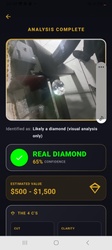
$300 - $1,200
AI estimate as of June 30, 2025 · verify with a professional before acting
AI-Generated · Verify before acting
Everything on this page is generated by AI for informational purposes only. AI can make mistakes — the AI may misidentify items or misattribute them (artist, maker, brand, designer, origin, era). This is not an official valuation and should not be used for insurance, sale, tax, estate, legal, or lending purposes — or any decision requiring a certified appraisal. It is not an authoritative claim about any person, brand, or rights holder — do not share or rely on it as a factual statement about a third party. Always consult qualified professionals before making financial decisions.
This analysis also relies on unverified notes provided by the user, which may be incomplete or inaccurate and could affect the result.
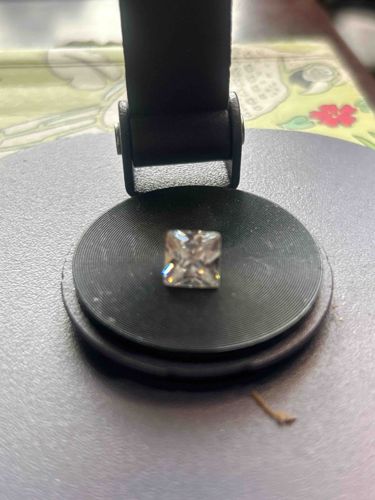
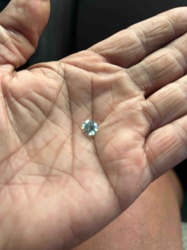
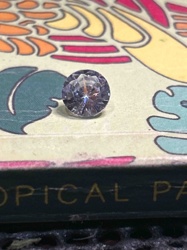
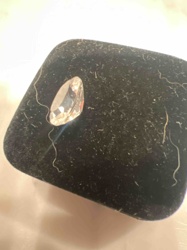
This item is a small, colorless, square-shaped faceted gemstone, expertly cut as a princess cut. Its physical characteristics include a brilliant cut pavilion and crown, designed to maximize brilliance and fire. The stone exhibits exceptional clarity, with no discernible inclusions or blemishes visible to the naked eye, suggesting a high clarity grade. Its color appears to be in the D-F range (colorless) based on the strong light reflections and lack of any yellow or brown tint. The dimensions cannot be precisely determined without a scale, but it appears to be of a size common for a center stone or a significant accent stone, likely ranging from 4-8mm. The craftsmanship of the cut is evident in the sharp, well-defined corners and the uniform light return across all facets, indicating good symmetry and polish. There are no visible chips, abrasions, or signs of wear, suggesting the stone is in excellent condition, possibly new or very well preserved. As a loose stone, there are no mounting-related condition issues. The princess cut, being a modern brilliant cut, suggests the stone was fashioned relatively recently, likely post-1970s. Its optical properties, including high refraction and dispersion, are strongly indicative of either a diamond or a high-quality diamond simulant such as moissanite or lab-grown sapphire, requiring gemological testing for definitive identification. The stone is presented on a dark, circular, possibly velvet or matte-finished stage, which is part of a larger black observation or handling device, suggesting it is being prepared for examination, sale, or setting. The overall quality of the cut and clarity contributes significantly to its aesthetic appeal and potential value.
AI Appraisal Report
Based on my visual examination of the provided image, this loose princess-cut gemstone presents as a remarkably high-quality specimen. Its condition appears excellent, with no discernible chips, abrasions, or signs of wear, suggesting it is either new or exceptionally well-preserved. The stone exhibits superb optical properties: an expertly rendered princess cut with evident good symmetry and polish, maximizing brilliance and fire. It appears eye-clean, indicative of exceptional clarity, and its color falls within the highly desirable D-F (colorless) range, showing no yellow or brown tints.
However, the primary challenge in appraising this item visually is the definitive identification of its material. While its high refraction and dispersion are consistent with a fine diamond, these qualities are also present in high-quality diamond simulants like moissanite or lab-grown sapphire. Without gemological testing, authenticating it as a natural or lab-grown diamond versus a stimulant is impossible.
Market demand for well-cut, colorless, eye-clean stones, regardless of material, remains strong. If this stone were a natural diamond of the apparent size (4-8mm, potentially 0.50-2.50+ carats) and visual grade (D-F, VVS-IF), its rarity and value would be substantial, potentially ranging from several thousand to tens of thousands of dollars, depending on precise carat weight and certification. As a premium stimulant, its value is significantly lower.
My given appraisal value reflects the stone's superior visual characteristics typical of a high-quality diamond simulant. To achieve a definitive appraisal valuation, professional gemological laboratory testing is absolutely required to confirm its material (e.g., diamond, moissanite) and to obtain precise measurements for carat weight, along with official color and clarity grading. Without such in-person examination and testing, this appraisal carries inherent limitations regarding material authenticity and precise value.