These notes were written by the person who submitted this item. Appraiser.AI has not verified them, and the AI's identification and estimate may rely on them.
AI Estimated Value
Not an official valuation
$150 - $300
AI estimate as of November 2, 2025 · verify with a professional before acting
AI-Generated · Verify before acting
Everything on this page is generated by AI for informational purposes only. AI can make mistakes — the AI may misidentify items or misattribute them (artist, maker, brand, designer, origin, era). This is not an official valuation and should not be used for insurance, sale, tax, estate, legal, or lending purposes — or any decision requiring a certified appraisal. It is not an authoritative claim about any person, brand, or rights holder — do not share or rely on it as a factual statement about a third party. Always consult qualified professionals before making financial decisions.
This analysis also relies on unverified notes provided by the user, which may be incomplete or inaccurate and could affect the result.
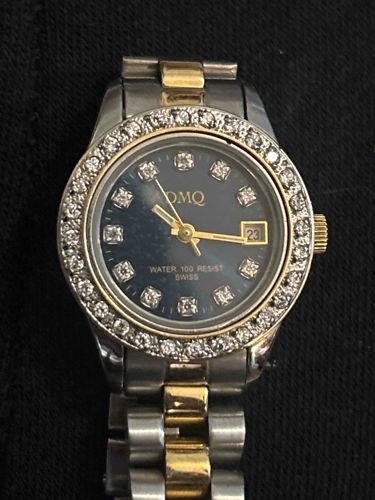
This is a ladies' analog wristwatch by the brand OMQ, featuring a two-tone design with gold-tone and silver-tone metals. The watch has a round case with a prominent bezel encrusted with what appear to be numerous small, clear stones, likely diamonds or diamond simulants, set in a pave style. The dial is a deep navy blue or dark gray color, with gold-tone hour, minute, and seconds hands. Instead of traditional numerals, the hour markers are represented by small, clear faceted stones, matching those on the bezel, set in gold-tone surrounds. There is a date display window positioned at the 3 o'clock mark, showing the number '23' on a white background with black text. Below the center of the dial, the text 'WATER 100 RESIST' and 'SWISS' are printed in white, indicating water resistance up to 100 meters and Swiss manufacturing or movement. The crown at the 3 o'clock position is gold-toned and fluted. The bracelet is a jubilee-style, two-tone construction, combining wider silver-tone outer links with narrower gold-tone central links. The overall aesthetic suggests a luxury or dress watch style, likely from the late 20th or early 21st century. The condition appears to be good with some visible wear on the gold-tone elements of the bracelet, consistent with regular use. The sparkle of the stones on the bezel and dial indicates a desire for elegance and visual appeal.
AI Appraisal Report
Upon examining the provided images and description of this ladies' OMQ Two-Tone Date Watch, I have formulated the following professional appraisal. The watch presents in good, used condition, exhibiting some wear on the gold-tone plating of the jubilee-style bracelet, which is consistent with regular use. The overall design, featuring a navy blue dial, stone-set hour markers, a date complication, and a prominent stone-encrusted bezel, is styled after popular luxury models. The brand 'OMQ' is not a widely recognized high-end or luxury Swiss manufacturer, which significantly impacts its secondary market value. Such brands often use base metals with gold-tone plating and diamond simulants like cubic zirconia or crystals, rather than solid gold and genuine diamonds. Market comparables for similar non-luxury, Swiss-parts fashion watches typically place them in a modest price bracket. Demand for this style is moderate, but brand recognition is a primary driver of value, which is low in this case. The 'SWISS' marking could refer to the movement, case, or full assembly, but without a known high-end brand, it doesn't substantially elevate the price. The 'WATER 100 RESIST' feature is standard. A key limitation of this appraisal is the inability to authenticate the materials from images alone. A physical inspection would be required to test the metals (to confirm if they are plated or solid gold), and a gemologist would need to examine the stones to determine if they are diamonds or simulants. Without original papers, a box, or service history, and assuming the materials are plated base metal and crystal, the fair market value is limited. Full authentication would require non-invasive XRF testing for metal composition and gemological testing of the stones.