These notes were written by the person who submitted this item. Appraiser.AI has not verified them, and the AI's identification and estimate may rely on them.
AI Estimated Value
Not an official valuation
$800 - $1,500
AI estimate as of August 19, 2025 · verify with a professional before acting
AI-Generated · Verify before acting
Everything on this page is generated by AI for informational purposes only. AI can make mistakes — the AI may misidentify items or misattribute them (artist, maker, brand, designer, origin, era). This is not an official valuation and should not be used for insurance, sale, tax, estate, legal, or lending purposes — or any decision requiring a certified appraisal. It is not an authoritative claim about any person, brand, or rights holder — do not share or rely on it as a factual statement about a third party. Always consult qualified professionals before making financial decisions.
This analysis also relies on unverified notes provided by the user, which may be incomplete or inaccurate and could affect the result.
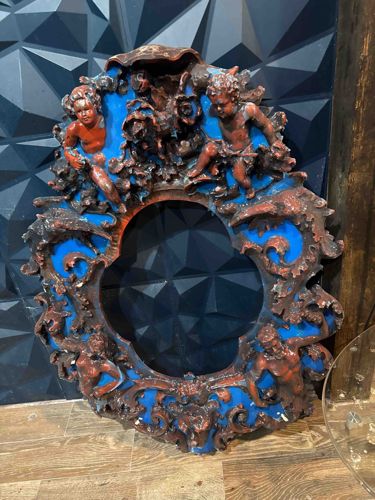
This is an elaborate antique mirror frame, likely originally intended for a large wall mirror. The frame boasts a highly ornate, asymmetrical shape, characteristic of the Rococo or Baroque style, though with a flamboyant color palette suggesting later revivalist periods or an eclectic aesthetic. Its dimensions appear to be substantial, possibly over two feet in height and width, judging by its visual scale. The material seems to be carved wood, possibly gessoed and then painted, as evidenced by the deep, irregular textures and areas where paint has flaked. The primary colors are a striking, vibrant medium blue, visible in the recesses and background elements, contrasted dramatically with a coppery-red or rust-brown hue that covers the raised, three-dimensional carvings. These carvings depict numerous putti (cherubs or cupid-like figures) intertwined with highly sculptural foliage, shells, and C-scrolls, typical of naturalistic Rococo ornamentation. There appear to be at least four putti visible; two at the top (one on each side), and two at the bottom, one on each side. Each putto is rendered with classical features and dynamic poses, some clambering among the leaves. The craftsmanship indicates hand-carving and meticulous attention to detail in the sculptural elements. Condition issues include significant paint loss, especially from the raised copper-red areas, revealing what might be the original material or an earlier layer of gesso beneath. There are also visible chips and wear along the edges and high points of the carving, consistent with age and handling. The patina of the copper-red paint suggests a metallic pigment, possibly an aged bronzing. The overall construction appears solid, with no major breaks or structural damage immediately apparent, though the surface wear is extensive. The interior opening suggests an oval or quatrefoil shape, designed to hold a mirror or perhaps a large painting. No discernible maker's marks or signatures are visible in the provided image. The juxtaposition of the bold blue with the metallic-toned carvings gives it a unique, almost theatrical quality, indicative of a piece that was once very grand and designed to make a statement.
AI Appraisal Report
Upon examining the details provided for this Rococo/Baroque style carved mirror frame with Putti, I can offer an informed appraisal. Based on the visual information, the frame appears to be hand-carved wood, likely gessoed and painted. The asymmetry, C-scrolls, and naturalistic putti intertwined with foliage are hallmarks of the Rococo period. However, the vibrant blue and coppery-red color scheme is highly unusual for a primary Rococo palette, suggesting either a later revivalist piece, an eccentric original choice, or a subsequent repainting. This eclectic aesthetic could appeal to certain collectors, but it deviates from the more traditional gilded or natural wood finishes typically associated with authentic 18th-century Rococo.
The condition, as described, shows significant paint loss, chips, and wear consistent with age and handling. While structurally sound without major breaks, the extensive surface degradation impacts its presentational value. Authenticity from images alone is limited; while the carving style aligns, confirmation of age and material (e.g., specific wood type, gesso composition, paint layers) would require in-person examination, including UV light inspection and potentially micro-analysis of pigment layers to determine if the current color scheme is original or later. Provenance documentation would also be crucial.
Market conditions for large, decorative antique frames are generally stable, with demand for highly ornate pieces. However, the unusual color scheme and condition issues would narrow its appeal compared to a well-preserved, traditionally gilded example. Comparables would include other elaborately carved Rococo/Baroque-style frames, but the unique color combination makes direct comparisons challenging. The presence of putti is a desirable feature, adding to its decorative appeal. Given the condition and the uncertainty regarding the originality of the striking color palette, which could be a detractor for purists but an attraction for others, its value is moderately impacted. A full authentication would necessitate hands-on inspection to assess the substrate, the layers of gesso and paint, and potential evidence of restoration or alterations.