These notes were written by the person who submitted this item. Appraiser.AI has not verified them, and the AI's identification and estimate may rely on them.
AI Estimated Value
Not an official valuation
$800-$1,500
AI estimate as of September 2, 2025 · verify with a professional before acting
AI-Generated · Verify before acting
Everything on this page is generated by AI for informational purposes only. AI can make mistakes — the AI may misidentify items or misattribute them (artist, maker, brand, designer, origin, era). This is not an official valuation and should not be used for insurance, sale, tax, estate, legal, or lending purposes — or any decision requiring a certified appraisal. It is not an authoritative claim about any person, brand, or rights holder — do not share or rely on it as a factual statement about a third party. Always consult qualified professionals before making financial decisions.
This analysis also relies on unverified notes provided by the user, which may be incomplete or inaccurate and could affect the result.
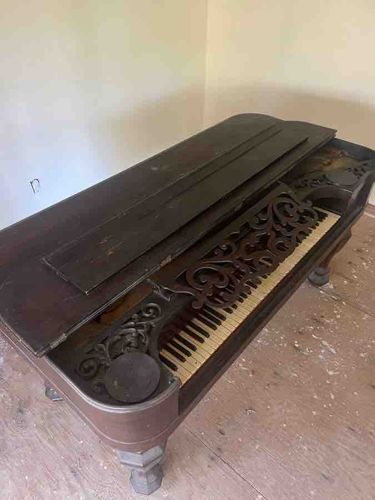
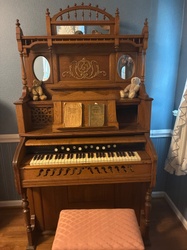
This item is an antique square grand piano, likely constructed from a dark hardwood, possibly mahogany or walnut, with a rich, dark patina. It features a broad, flat top characteristic of square grand pianos, with visible age and wear, including some scratches and possible discoloration on its surface. The instrument rests on four sturdy, octagonal-shaped wooden legs, indicative of its robust construction. A striking feature is the ornate, dark metal (likely cast iron) scrollwork music stand and side panels, which display intricate floral or foliate patterns, typical of mid-19th century decorative arts. The keyboard features keys that appear to be made of ivory (for the white keys) and ebony or stained wood (for the black keys), with visible yellowing and wear on the white keys, indicating age and use. There are also circular, possibly brass or cast iron, decorative elements near the ends of the keyboard, integrated into the decorative metalwork. The overall condition suggests significant age, with expected wear and tear for a piece from the 1860s, including surface abrasions and dust accumulation, but no obvious catastrophic damage such as large missing pieces or major structural breaks are immediately apparent. The visible craftsmanship in the carving and metalwork suggests a quality piece of its era. The 'Boardman, Gray & Co. Patented May 1st, 1860, Albany' marking confirms its manufacturer, patent date, and origin, placing it squarely in the mid-19th century, likely from the American Victorian era.
AI Appraisal Report
Based on my examination of the provided image and the owner's details, this is a Boardman, Gray & Co. Square Grand Piano, clearly marked as 'Patented May 1st, 1860, Albany.' This marking definitively authenticates its manufacturer and era. The piano exhibits characteristics typical of a mid-19th century square grand, including a dark hardwood construction (likely mahogany or walnut), robust octagonal legs, and ornate cast iron scrollwork for the music stand and side panels, which is a desirable aesthetic feature. The keys show expected yellowing and wear on the ivory, consistent with its age. While there are visible surface abrasions, scratches, and dust accumulation, no catastrophic damage or major structural breaks are apparent. This suggests it is largely intact, which is crucial for antique musical instruments. The craftsmanship is evident, pointing to a quality piece for its time.
From a market perspective, square grand pianos, while historically significant, generally do not command high prices in today's market compared to other antique furniture or musical instruments. Their large size, weight, and the significant cost of restoration (especially for playability) deter many potential buyers. Demand is niche, appealing primarily to collectors, museums, or individuals interested in historical décor. Rarity is moderate; while a specific manufacturer and patent date add to its unique historical narrative, square grand pianos were produced in relatively large numbers during their popular era.
Factors significantly impacting its value include its complete condition (no major missing elements), the clear manufacturer's mark, and the aesthetic appeal of the ornate metalwork. Conversely, the high cost of professional restoration to playing condition, shipping challenges, and its sheer size are depreciating factors. Without an in-person examination, I cannot definitively assess the internal mechanisms, the integrity of the soundboard, or the pin block, which are critical for playability and structural soundness. Provenance documentation beyond the visible markings would add further value. My appraisal range reflects its value primarily as a significant historical and decorative artifact, rather than a playable instrument without substantial investment.