AI estimate as of November 17, 2025 · verify with a professional before acting
AI-Generated · Verify before acting
Everything on this page is generated by AI for informational purposes only. AI can make mistakes — the AI may misidentify items or misattribute them (artist, maker, brand, designer, origin, era). This is not an official valuation and should not be used for insurance, sale, tax, estate, legal, or lending purposes — or any decision requiring a certified appraisal. It is not an authoritative claim about any person, brand, or rights holder — do not share or rely on it as a factual statement about a third party. Always consult qualified professionals before making financial decisions.
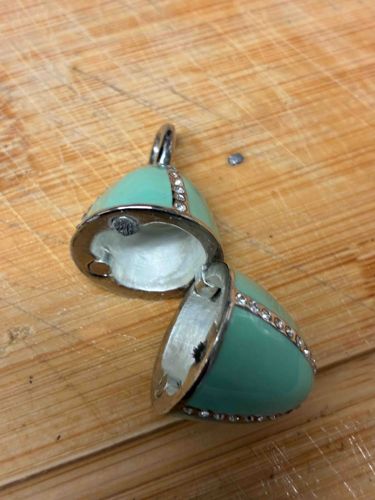
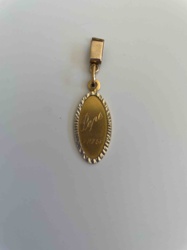
This item is a decorative locket pendant, shaped like an egg and designed to open into two halves. Its primary coloration is a vibrant, glossy teal or mint green enamel, applied to the exterior of both halves. The metal visible is a bright, polished silver-tone, likely a base metal plated with silver or rhodium, given its reflective quality. Each half of the egg is adorned with a band of small, clear rhinestones, set along the seam where the two halves meet when closed, as well as around the base of each half. There appears to be a small hinge mechanism connecting the two halves, allowing the egg to open and reveal a hollow interior. The interior of the locket is also coated in a smooth, off-white or light cream enamel, providing a clean contrast to the exterior. A bail is incorporated at the top of one half, indicating its function as a pendant to be worn on a necklace. Notably, there's a small, circular impression or marker inside the top half of the locket, potentially a manufacturer's mark or stamp, though it's illegible from the image. The overall construction suggests a jewelry piece, likely contemporary in style, possibly manufactured in the late 20th or early 21st century. The rhinestones are uniformly set, suggesting mass production. There are no significant signs of wear, damage, or repairs visible, though some minor scratches or scuffs might be present on the interior silver-tone surface due to handling or age. The craftsmanship appears to be of a decent commercial quality, typical of costume jewelry. Its unique aspect is the egg shape combined with the locket function and vibrant enamel.
AI Appraisal Report
Upon visual examination of the provided image, I assess this Teal Enamel and Rhinestone Egg Locket Pendant to be in very good condition. There are no obvious signs of significant wear, damage, or repairs, though minor superficial scratches on the interior silver-tone are possible and typical for handled costume jewelry. Authenticity, based solely on visual cues, suggests it is a commercial-grade costume jewelry piece, likely manufactured in the late 20th or early 21st century. The uniform setting of the rhinestones and the consistent enamel application point to mass production.
Market conditions for costume jewelry of this type are generally stable. Comparable items, often found in vintage or contemporary costume jewelry markets, typically fall within a modest price range. Demand for general costume pendants, even with a unique form factor like an egg locket, is not exceptionally high unless associated with a well-known designer or brand, which is not indicated here. Rarity is low; pieces with similar materials and craftsmanship are readily available.
Factors significantly impacting value include its base metal construction, enamel finish, and the use of rhinestones rather than genuine gemstones. The locket function and vibrant teal color are appealing but do not elevate its intrinsic value substantially. The illegible mark inside could be a manufacturer's identification, which, if decipherable and from a reputable brand, might slightly increase value.
It is crucial to note the limitations of authenticity verification from images alone. A physical in-person examination would be necessary to confirm metal composition (e.g., sterling silver vs. plated base metal), the security of the rhinestone settings, and the true condition of the enamel and hinge mechanism without photographic limitations. Provenance documentation or scientific testing (like XRF analysis for metal composition) would be needed for full authentication and a more precise valuation beyond the costume jewelry category.