AI Appraisal Estimate

AI-generated estimates · not official valuations

From the user

What was submitted

Photo and notes provided by the user — not generated by AI

Submitted item photo
Submitted photo · June 3, 2026

User's notes

No additional notes provided.

AI analysis below

AI appraisal

AI analysis & estimate

AI-Generated · Verify before acting

Everything below is generated by AI for informational purposes only. AI can make mistakes — the AI may misidentify items or misattribute them (artist, maker, brand, designer, origin, era). This is not an official valuation and should not be used for insurance, sale, tax, estate, legal, or lending purposes — or any decision requiring a certified appraisal. It is not an authoritative claim about any person, brand, or rights holder — do not share or rely on it as a factual statement about a third party. Always consult qualified professionals before making financial decisions.

Read the full disclaimer

AI Identification

·Not independently authenticated·Verify before acting

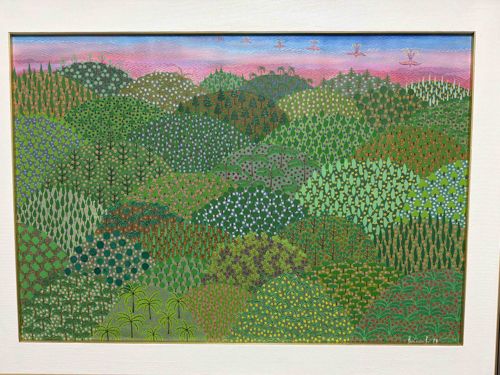
Naïve Landscape Painting with Rolling Hills

Fine Art - Paintings

AI Estimated Value

·Not an official valuation·Verify before acting

$1,200 - $1,800

As of June 3, 2026

AI Item Analysis

·AI can make mistakes·Verify before acting
This artwork is a vibrant landscape painting in a Naïve or Folk art style, characterized by its repetitive patterns and lack of traditional linear perspective. The composition features a dense arrangement of layered, rounded hills, each individually patterned with meticulous dots and shapes representing various types of vegetation and trees. The color palette is dominated by a rich array of greens—ranging from deep forest to bright lime—punctuated by small white, red, and yellow accents that suggest flowers or fruit. The sky is rendered in horizontal gradients of blue and soft pink, with stylized, bird-like shapes or small floating figures spaced across the horizon line. In the bottom-right corner, there is a visible signature and date, appearing to read 'Pascale 76' or similar, indicating it was produced in 1976. The medium appears to be acrylic or oil on a flat substrate, possibly canvas board or paper. The craftsmanship is highly detailed, utilizing a pointillist-adjacent technique to create texture. The piece is housed behind a white mat with a thin gold-toned inner fillet and a larger white frame. The condition appears stable with no immediate signs of fading or mechanical damage, though some slight undulation in the paper might be present under the glazing.


AI Appraisal Report

·AI can make mistakes·Verify before acting
I have completed a visual examination of the Naïve landscape painting signed 'Pascale 76.' This work is a quintessential example of 20th-century Folk Art, characterized by rhythmic, repetitive patterns and a compressed, non-linear perspective. The 'pointillist-adjacent' execution shows a high degree of technical patience and aesthetic consistency. Based on current imagery, the condition appears stable; the pigments remain vibrant, suggesting minimal UV exposure. The minor undulation noted in the substrate is typical for paper-based media and does not significantly detract from the value, though it suggests the piece may need a conservation-grade mounting check. The market for mid-century Naïve and Primitivist art remains robust, particularly for works displaying this level of intricate detail and vibrant color palettes. Comparables for signed, dated works from the 1970s in this style typically fetch between $1,000 and $2,500 at specialized folk art auctions. The specific 'Pascale' signature likely refers to a regional artist of the era; identification of the specific artist's biography would potentially elevate the value further. Limitations: This appraisal is based solely on high-resolution digital imagery. A definitive authentication requires an in-person inspection to verify the medium (acrylic vs. oil), examine the substrate for watermarks or age-appropriate oxidation, and inspect the verso for gallery labels or provenance markings. Scientific testing of the binder and pigments could confirm the 1970s origin. Furthermore, I recommend removing the frame to check for acid burn from the current matting, as this affects long-term preservation and valuation.

Get your items appraised

Instant estimates of your treasures with AI-powered appraisals

Browse More Appraisals