AI estimate as of July 10, 2025 · verify with a professional before acting
AI-Generated · Verify before acting
Everything on this page is generated by AI for informational purposes only. AI can make mistakes — the AI may misidentify items or misattribute them (artist, maker, brand, designer, origin, era). This is not an official valuation and should not be used for insurance, sale, tax, estate, legal, or lending purposes — or any decision requiring a certified appraisal. It is not an authoritative claim about any person, brand, or rights holder — do not share or rely on it as a factual statement about a third party. Always consult qualified professionals before making financial decisions.
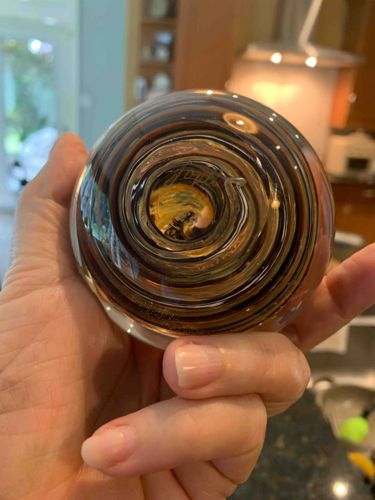
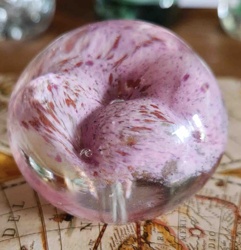
This item is a spherical art glass paperweight, characterized by its transparent glass body encasing a complex, swirling internal design. The dominant colors within the swirl are rich browns and amber tones, with subtle hints of lighter, almost yellow or gold accents, particularly towards the center of the spiral. The design forms a distinct spiral or vortex pattern, beginning at the core and expanding outwards, creating a sense of depth and movement within the solid glass. The glass itself appears highly polished and clear, allowing the internal design to be clearly visible and contributing to its optical quality. There are no immediately apparent chips, cracks, or significant abrasions on the exterior surface, suggesting good preservation. The craftsmanship indicates a hand-blown or lamp-worked glass piece, given the fluidity and organic nature of the internal patterns. While no maker's marks or signatures are visible from this perspective, such pieces often have polished pontil marks or engraved signatures on the flat base, which is not shown. The approximate size appears to be standard for a paperweight, likely fitting comfortably within the palm of a hand (as depicted). The style suggests a contemporary or late 20th-century to early 21st-century creation, typical of studio art glass. The deliberate layering and manipulation of colors and transparent glass demonstrate a high level of skill and artistic intent.
AI Appraisal Report
Based on my visual examination of the provided image, this art glass swirl paperweight presents in excellent condition. The transparent glass body appears free from chips, cracks, or significant abrasions, and its highly polished surface enhances the optical clarity of the internal design. The internal swirl, featuring rich browns, ambers, and subtle yellow accents, exhibits a fluid, organic quality indicative of skilled hand-blown or lamp-worked craftsmanship. The depth and movement created by the expanding vortex pattern demonstrate a high level of artistic intent and technical proficiency.
Authenticity, while strongly suggested by the craftsmanship, cannot be definitively verified from images alone. The fluidity of the internal patterns suggests a studio art glass piece, likely late 20th to early 21st century. However, without physical examination, I cannot confirm the presence of a polished pontil mark, engraved signature, or other identifying maker’s marks typically found on the base, which would be crucial for precise attribution and authenticity.
In terms of market conditions, art glass paperweights with intricate internal designs and excellent condition generally maintain steady demand, especially those displaying unique artistic merit and skilled execution. Comparable pieces by unidentifiable but clearly competent glass artists often retail in the low to mid-hundreds. Rarity is difficult to assess without maker identification, but the quality of this specific design suggests it is not a mass-produced item. Factors impacting value positively include its pristine condition and the complexity of the internal design. Without a maker's mark or definitive provenance, a significant increase in value beyond this estimate would be speculative.
For full authentication and a more precise valuation, an in-person examination is essential to inspect the base for signatures or marks, assess the true optical quality and weight, and potentially conduct scientific testing if provenance documents were to suggest a high-value artist. Provenance documentation detailing its origin and history would further solidify its value. Given these limitations, the appraisal value reflects the piece's aesthetic quality and condition as an unmarked, but well-executed, contemporary art glass paperweight.