These notes were written by the person who submitted this item. Appraiser.AI has not verified them, and the AI's identification and estimate may rely on them.
AI Estimated Value
Not an official valuation
$150-$250
AI estimate as of August 26, 2025 · verify with a professional before acting
AI-Generated · Verify before acting
Everything on this page is generated by AI for informational purposes only. AI can make mistakes — the AI may misidentify items or misattribute them (artist, maker, brand, designer, origin, era). This is not an official valuation and should not be used for insurance, sale, tax, estate, legal, or lending purposes — or any decision requiring a certified appraisal. It is not an authoritative claim about any person, brand, or rights holder — do not share or rely on it as a factual statement about a third party. Always consult qualified professionals before making financial decisions.
This analysis also relies on unverified notes provided by the user, which may be incomplete or inaccurate and could affect the result.
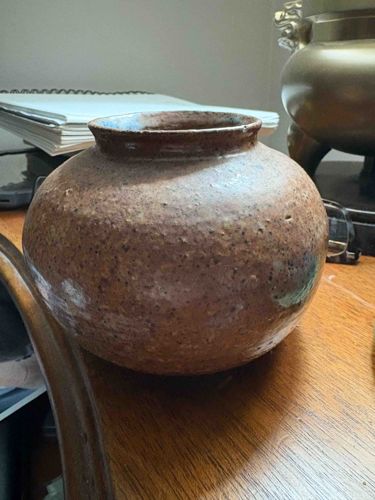
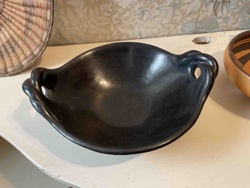
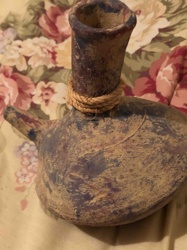
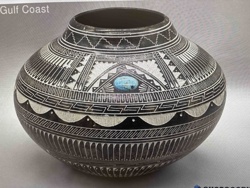
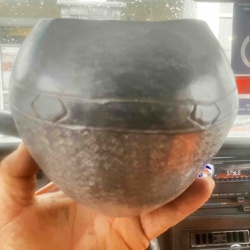
This is a globular stoneware pottery vessel, likely a jar or a small pot, characterized by its rustic and unrefined appearance. Its physical characteristics include a rounded, squat body that tapers slightly towards a short, flared rim or neck. The material appears to be a coarse stoneware clay, evident from the visible flecks of darker minerals within the lighter brown matrix. The predominant color is an earthy reddish-brown, variegated with lighter tan and darker specks, giving it a mottled or speckled effect. The surface texture is notably rough and tactile, indicative of an unglazed or roughly glazed exterior, possibly with some areas of crystallization or 'crazing' as part of the firing process. The construction appears to be hand-thrown, suggested by the slight irregularities in its spherical form.
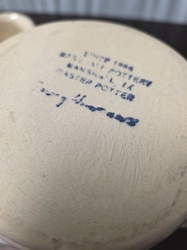
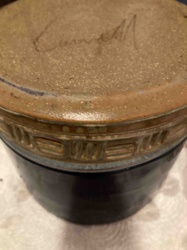
Observable features include a visible lip on the interior of the rim, which shows a faint bluish or greenish tint, possibly from a different glaze application or an internal chemical reaction during firing. No overt damage like chips or cracks are immediately discernible, but the overall patina suggests age and handling. The 'Coyne' marking on the bottom indicates a potential maker's mark or artist's signature, pointing towards a studio pottery piece rather than mass-produced ware. This would place its estimated age likely in the 20th century, possibly mid to late, reflecting the resurgence of handcrafted ceramics. The craftsmanship, while appearing rustic, shows deliberate formation and attention to the material's natural characteristics, suggesting a quality piece for its style.
AI Appraisal Report
I have carefully examined the provided image and description of this Studio Pottery Globular Jar by 'Coyne'.
**Condition and Authenticity:** The vessel appears to be in very good, consistent with age, pre-owned condition with no obvious chips or cracks visible from the image. The rustic surface texture, visible mineral flecks, and natural variations in color are inherent to the intended aesthetic and material, not indicative of damage. The faint bluish/greenish tint on the interior rim is likely a result of the firing process or a specific glaze, adding to its uniqueness. The visible 'Coyne' mark on the bottom strongly suggests authenticity as a studio pottery piece; however, without a physical examination, I cannot definitively verify the mark's true authenticity or rule out potential restorations that are not visible in the image. I would need to physically inspect the piece to confirm the mark's impression and examine the surface under various lighting conditions for repairs.
**Market Conditions and Comparables:** Studio pottery from the mid to late 20th century, particularly pieces with unique glazes and forms, has a steady, though not exceptionally high, demand. Pieces by lesser-known but skilled potters like 'Coyne' (assuming this is a known name within studio pottery circles, which would require further research) typically appeal to collectors of handcrafted ceramics, folk art, and rustic decor. Comparable works by regional studio potters of the period generally achieve modest prices unless the artist is highly renowned.
**Demand and Rarity:** While not museum-grade rare, individual studio pottery pieces are inherently unique due to their handmade nature. The demand is niche but consistent among collectors who appreciate artisanal craftsmanship over mass production. The 'Coyne' signature adds to its collectibility, but the rarity depends on the artist's output and recognition.
**Factors Impacting Value:** The primary factors impacting value are its condition, the attribution to 'Coyne', and the aesthetic appeal of its rustic form and texture. The lack of overt damage and the distinctive, earthy aesthetic are positives. The main limitation in assessing value from an image is the inability to fully inspect for subtle flaws, restorations, or the tactile quality of the surface. Provenance documentation (e.g., original purchase receipts, exhibition history) would significantly enhance value and authenticity confirmation, as would scientific analysis of the clay body or glazes if there were doubts about its age or origin.
**Limitations:** Without a physical inspection, I cannot confirm the exact nature of the clay, the integrity of the firing, or detect any hairline cracks or subtle repairs that might not be visible in the provided image. The authenticity of the 'Coyne' mark would also benefit from in-person verification against known examples of the artist's work, if available.