AI estimate as of September 27, 2025 · verify with a professional before acting
AI-Generated · Verify before acting
Everything on this page is generated by AI for informational purposes only. AI can make mistakes — the AI may misidentify items or misattribute them (artist, maker, brand, designer, origin, era). This is not an official valuation and should not be used for insurance, sale, tax, estate, legal, or lending purposes — or any decision requiring a certified appraisal. It is not an authoritative claim about any person, brand, or rights holder — do not share or rely on it as a factual statement about a third party. Always consult qualified professionals before making financial decisions.
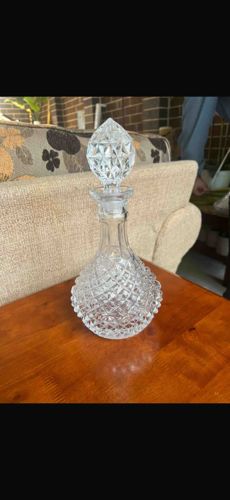
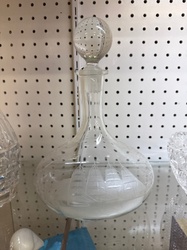
This is a clear glass decanter featuring a spherical body and a narrow, elongated neck, topped with a substantial, faceted stopper. The decanter is constructed from clear, possibly leaded, glass, which exhibits significant light refraction, indicative of its quality and composition. The main body of the decanter is adorned with an intricate diamond-cut pattern, typical of pressed or cut glass from the late 19th to mid-20th century. The geometric cuts create a textured surface that catches and disperses light effectively. Around the base of the spherical body, there is a distinct ring of small, circular, raised 'beads' or 'prunts' providing additional decorative detail and a tactile element. The neck is smooth and tapers gently upwards, flaring slightly at the rim to accommodate the stopper. The stopper itself is a prominent feature, carved into a faceted, ovoid shape, tapering to a point at its apex, with a matching diamond-cut pattern mirroring the decanter's body. The bottom portion of the stopper is ground to fit precisely into the decanter's opening, suggesting an original pairing. No visible manufacturing details such as maker's marks or signatures are discernable from the provided images. The overall condition appears good, with no obvious chips, cracks, or significant repair evident. The glass is clear and free from noticeable cloudiness or internal etching, suggesting it has been well-maintained. The style suggests a Victorian, Edwardian, or early 20th-century aesthetic, known for ornate and decorative glasswork. The craftsmanship, particularly the precision of the cuts and the fit of the stopper, indicates a quality piece designed for alcoholic beverages like whiskey or wine.
AI Appraisal Report
I have examined the provided image of this Cut Glass Decanter with Faceted Stopper. Based on the visual evidence, the decanter appears to be in very good condition, with no visible chips, cracks, or significant wear. The clarity of the glass and the precision of the diamond-cut patterns suggest a well-crafted piece, likely from the late 19th to mid-20th century, aligning with Victorian, Edwardian, or early 20th-century aesthetic trends. The matching faceted stopper, which appears to be original and well-fitted, further enhances its appeal and value. The 'beaded' ring at the base is a charming decorative detail. Authenticity, based solely on images, is generally assumed unless obvious discrepancies are noted; here, none are apparent. The quality of the cutting is good, but typical of mass-produced cut glass from this era, which, while attractive, doesn't achieve the rarity or premium of earlier, more intricate hand-cut pieces or those by renowned makers. Market comparables for similar well-preserved, unmarked cut glass decanters typically fall within the $100-$300 range, depending on the intricacy of the cut and overall condition. Demand for such barware is stable amongst collectors of antique glass and those furnishing period homes, but it is not considered rare. The absence of a maker's mark limits its potential for higher valuation. To fully authenticate its age, origin, and indeed, confirm lead content if suspected, an in-person examination would be crucial. Physical inspection would allow for tactile assessment of the glass quality, examination for faint manufacturing imperfections, and a check for any subtle repairs not visible in photographs. Provenance documentation, if available, would significantly enhance authenticity verification, and scientific testing like XRF could confirm glass composition.