AI estimate as of September 8, 2025 · verify with a professional before acting
AI-Generated · Verify before acting
Everything on this page is generated by AI for informational purposes only. AI can make mistakes — the AI may misidentify items or misattribute them (artist, maker, brand, designer, origin, era). This is not an official valuation and should not be used for insurance, sale, tax, estate, legal, or lending purposes — or any decision requiring a certified appraisal. It is not an authoritative claim about any person, brand, or rights holder — do not share or rely on it as a factual statement about a third party. Always consult qualified professionals before making financial decisions.
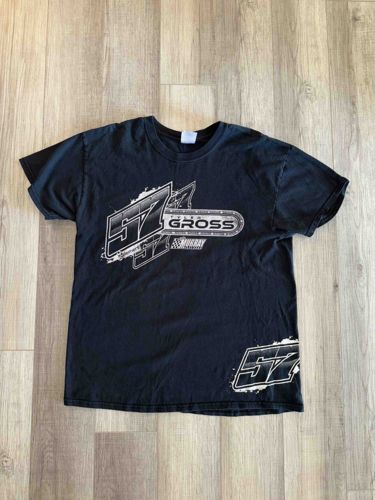
This is a vintage black short-sleeved t-shirt, likely made from 100% cotton or a cotton blend, presenting a somewhat faded appearance consistent with age and wear. The fabric exhibits a soft, worn texture, typical of older t-shirts. The shirt features a crew neck collar and standard short sleeves. The primary graphic on the front of the shirt is a stylized number '57' rendered in a bold, angular font with a distressed or grunge effect in white and light gray, giving it a dynamic, motion-like feel. Adjacent to the '57' is a horizontal rectangular design resembling a toolbox or a license plate, with the word 'GROSS' prominently displayed in white capital letters within it. Below 'GROSS', a smaller text or logo appears, which seems to read 'MURRAY', possibly indicating a sponsor or brand. The bottom right corner of the shirt also features a smaller, matching stylized '57' design, contributing to the overall racing or automotive theme. The print shows some evidence of cracking and fading, indicative of its age and washing cycles. The white neck tag is visible, but no specific brand or size information is discernible from the image. The construction appears to be standard t-shirt sewing, with discernible seams. There are no obvious rips, tears, or major repairs, but the overall patina suggests a well-loved item. Based on the graphics and stylistic elements, it likely dates from the late 1990s to early 2000s, reflecting the aesthetics of motorsports merchandise from that era. The craftsmanship appears to be typical mass-produced quality for a t-shirt, focused on durability for casual wear.
AI Appraisal Report
Upon visual examination of this vintage black 57 Gross Murray Racing T-shirt, I assess its condition as 'good-fair' for a vintage apparel item. The faded appearance, soft worn texture, and cracking/fading of the print are consistent with typical aging and wear, indicating a well-loved piece rather than a pristine collectible. There are no obvious rips, tears, or major repairs visible that would significantly devalue it. Authenticity, based solely on this image, appears consistent with genuine vintage wear for a mass-produced tee from the late 1990s to early 2000s; the fading and wear patterns seem organic. The '57' racing graphic, along with 'GROSS' and 'MURRAY,' points to a motorsports theme, which generally has a steady but niche demand within the vintage t-shirt market. While not a universally recognized iconic design or a rare brand collaboration, its appeal lies in its authentic vintage aesthetic and specific racing motif. Comparable vintage racing or automotive graphic tees from this era typically fetch in the $30-$80 range depending on condition, specific graphics, and brand recognition. Factors impacting value here include its good overall preservation despite wear, and the identifiable, although not highly famous, graphic elements. The primary limitation in authenticity verification from images alone is the inability to physically inspect the fabric quality, stitching details, and the neck tag for specific brand/size information or care instructions, which sometimes hold authenticity markers or specific production dates. A physical inspection would allow for tactile assessment of the fabric, seam integrity, and closer examination of the tag for definitive brand and origin details, while provenance documentation, if available, could confirm its history and specific release.